

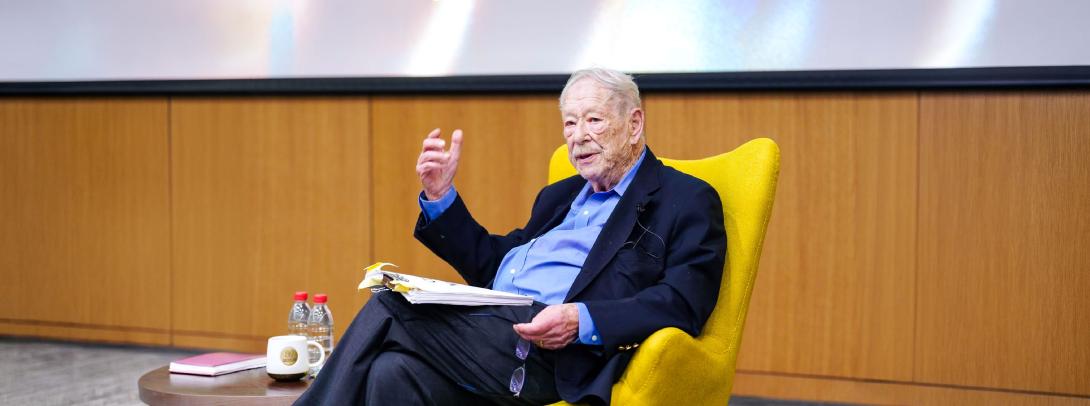
Former US Treasury Secretary W. Michael Blumenthal visited campus on October 19 and spoke to more than 200 students, faculty, and staff about his new book and his relationship with Shanghai that began nearly nine decades ago.
Vice Chancellor Jeffrey Lehman opened the event with an introduction to Blumenthal, who was joined in conversation by award-winning author Rachel DeWoskin.
Blumenthal first arrived in Shanghai in 1939 at age 13 after his family fled Nazi Germany. He stayed in the city until 1947, before moving to the United States, where he studied at the University of California, Berkeley and Princeton University, and built careers in business and government. He served as US Treasury Secretary under President Jimmy Carter and played a role in US-China relations during the period leading up to the normalization of diplomatic ties.
“Shanghai is a major factor influencing my whole development,” Blumenthal told the audience. “So I thought to myself, ‘Why don’t I write about my Shanghai?’”
That became City of Masks: The Seven Shanghais I Have Known, a historical spy novel set in wartime Shanghai. The protagonist, an American drifter and small-time criminal, arrives in the city while fleeing the law and is eventually drawn into espionage during the Japanese occupation.
“I’m not really a writer,” Blumenthal joked, admitting that he learned to write while serving in the State Department, where he had to prepare reports and telegrams with clarity, concision, and speed. “The only writing I learned was to write this kind of thing,” he said.
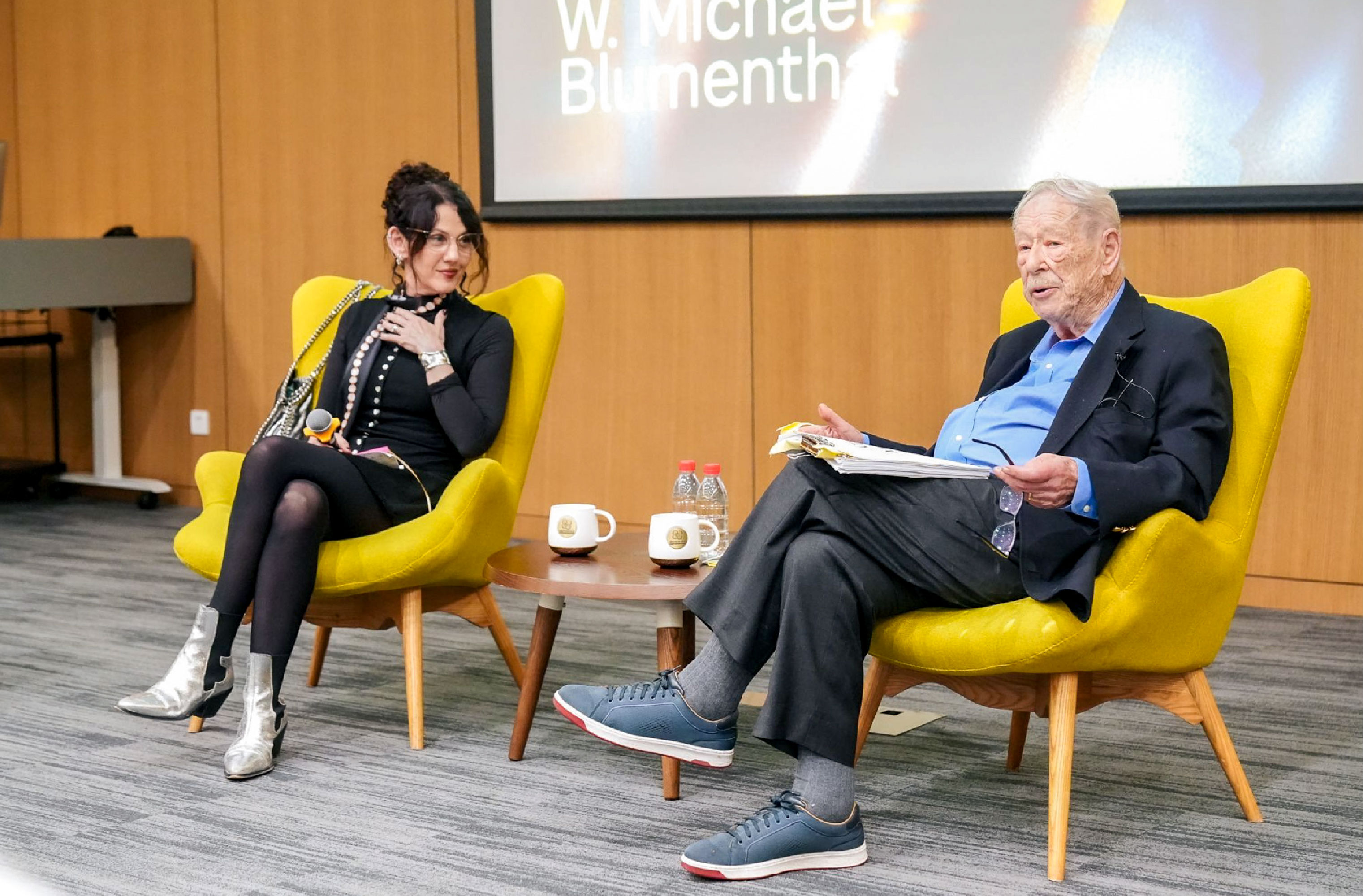
Blumenthal described his new novel as fiction grounded in a real historical world. The central plot and characters are invented, he said, but some historical figures are real, and he drew on both his memories of Shanghai and years of research to add context to the story.
When DeWoskin asked why he turned to fiction after publishing several works of nonfiction, Blumenthal said fiction offered far greater freedom.
“In a novel, you can go wild and crazy in your imagination,” he said. “You can be drawn into the life of the characters that you have created.”
During the event, he gave the first public reading from his novel. In it, Blumenthal describes war-time Shanghai, refuge to thousands fleeing persecution as well as a center of espionage during Japanese occupation with competing intelligence networks and political factions operating alongside one another.
The novel’s title comes from that world of hidden identities and shifting loyalties. Blumenthal said the Shanghai of that period was full of people who were not always what they appeared to be -- spies, mafia bosses fronting as respectable citizens, and political actors pursuing competing agendas.
During the discussion, Blumenthal revisited his childhood memories of Shanghai. His family arrived with little money and few certainties, he said, and years of war and displacement taught him how quickly titles, wealth, and status could lose their meaning.
“You better depend on yourself and don’t get too proud [of your status],” he said. “If you have a doctorate, under certain circumstances it doesn’t mean anything.”
He recalled seeing some refugees struggle after losing the status they had held in Europe, while others adapted, supported those around them, and found ways to start again. For Blumenthal, the lesson he took from the experience was to rely on one’s own inner resources.
Shanghai also exposed him at a young age to people from many countries and cultures, he said. The city he knew was unusually open but deeply unequal, where diplomats, businessmen, missionaries, adventurers, criminals, refugees, and local residents brushed shoulders.
“You learn very quickly not to be too comfortable in your culture in which you were raised, but to be exposed to many different cultures,” he said.
After emigrating to the US, Blumenthal decided to study economics and government, having been deeply impacted by witnessing the effects of poverty, war, and what he described as failures of government during his time in Shanghai.
“I had this idea that maybe if I studied it and learned a little bit more about it, and went into the government in my own country, I could contribute a little bit to just do it a little bit better,” he said.
Blumenthal has returned to Shanghai many times over the decades. He described the “seven Shanghais” he has known: the international city he encountered in 1939; Japanese-occupied Shanghai; the city he returned to as an American official in 1973; Shanghai around the time of US-China normalization; the city transformed by reform and opening in the 1990s; the rapidly changing Shanghai of later visits; and the Shanghai of today.
Each return, he said, has made the city harder to recognize, yet he remains struck by the scale and speed of its transformation. At 100, Blumenthal acknowledged that this could be his last visit to Shanghai.
Accompanied by his family on this trip, he made sure to visit places connected to his childhood and toured the Shanghai Jewish Refugees Museum.
Asked by DeWoskin what lessons could be taken from Shanghai’s experience sheltering roughly 18,000 Jewish refugees who fled here from Nazi Europe, Blumenthal said the local residents and the refugees learned to live alongside one another under extraordinarily difficult conditions, even as many local residents struggled with poverty and displacement.
That lesson of living alongside each other is still relevant today, Blumenthal said, as he advocated for accepting people regardless of language or cultural differences.
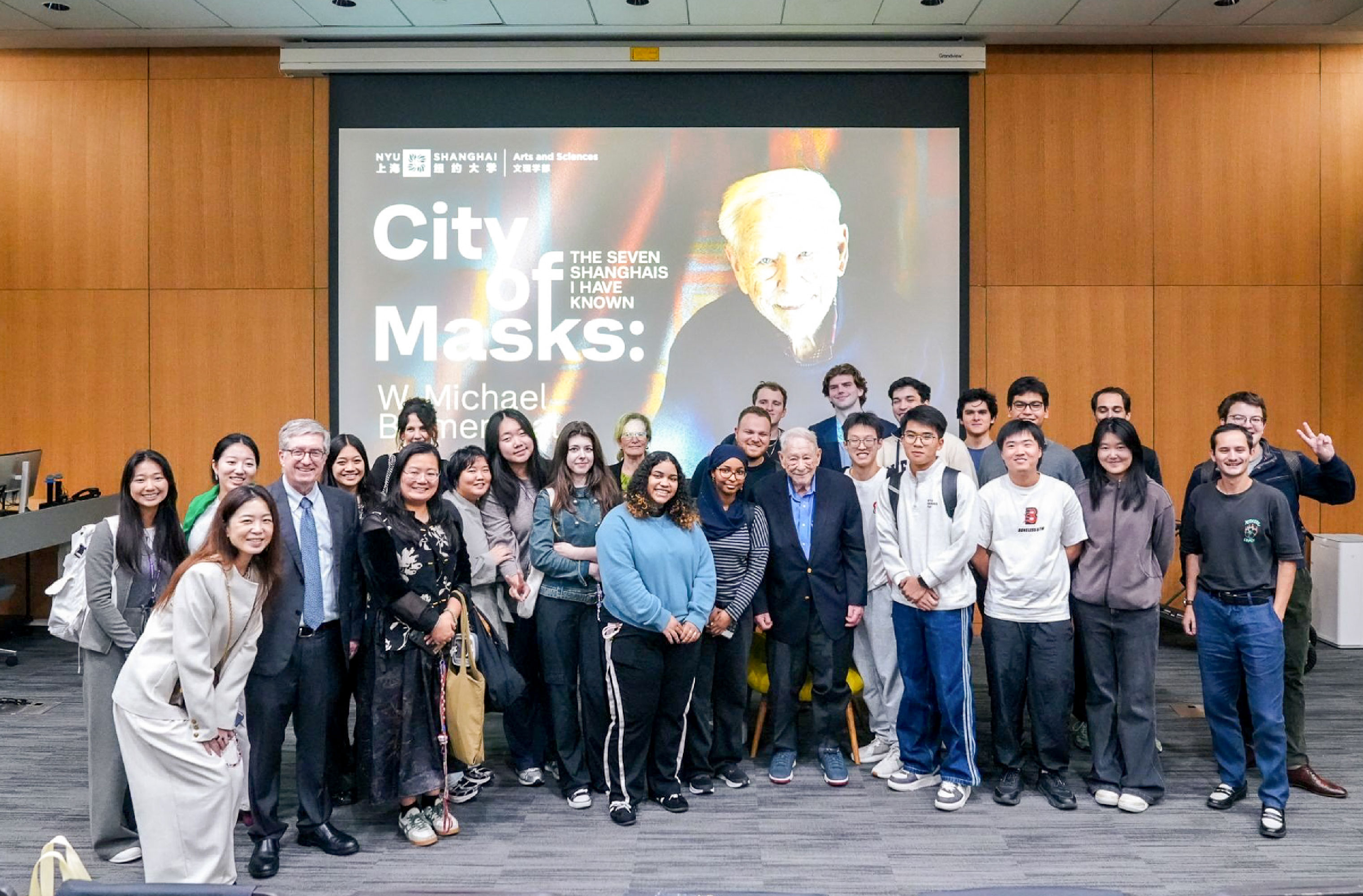
Blumenthal answered students’ questions about his life experiences and what a century of life had taught him about human nature. One student asked about staying optimistic after experiencing both cruelty and generosity throughout his life.
Blumenthal answered that human beings have repeatedly shown a capacity for both “enormous goodness and creativity” and for injustice and evil.
“Realistic optimism is the only sensible philosophy for someone who wants to go through life and create and achieve something,” he said. “I still have faith in humanity.”