

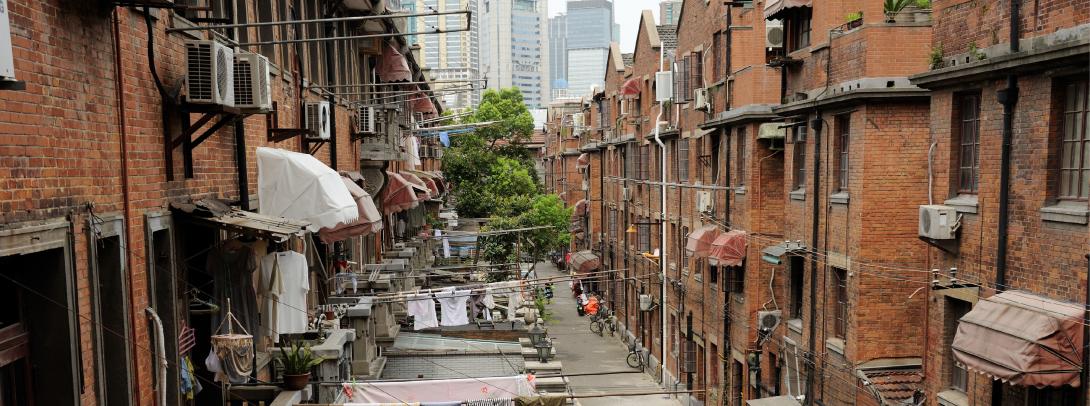
Walls covered with stickers and flyers. A pile of construction waste left at the corner of a residential compound. Potholes that never get fixed. Laundry, bicycles, trash bags, and aging public facilities crowding a shared space.
For many city residents, these sights are so ordinary that they fade into the backdrop. But sociologists see them as part of larger questions: Does neighborhood environmental decline reflect the dysfunction of a neighborhood, or merely its socioeconomic disadvantage? How does a neighborhood’s physical surroundings impact the mental health of its residents?
A new study co-authored by Assistant Professor of Sociology Miao Jia suggests that when a neighborhood shows visible signs of disorder and disrepair, residents may experience measurable mental health consequences. Published in Social Science & Medicine, the study examines how physical disorders in neighborhoods were associated with psychological distress among Shanghai residents from 2017 to 2019.
“After China’s economic reform, people’s daily lives have increasingly shifted from the work unit to the community,” said Miao. “That makes the neighborhood an important place for understanding how urban environments affect individual and family well-being.”
In sociology, “physical disorder” refers to visible signs of neglect in public spaces, such as litter, graffiti, broken infrastructure, illegal posters, construction debris, or deteriorating elements in the streetscape. In many Western studies, these signs have been understood as signals of urban decline and weakened community organization. But Miao noted that the Chinese urban context complicates this relationship.
“In Western research, disorder is often seen as a sign that community organization has broken down,” she said. “But in China, community life is also organized through institutions such as residents’ committees (ju wei hui). A reduction in disorder may come not only from residents acting collectively, but also from state-led neighborhood governance and improvement.”
Shanghai proved a particularly valuable case. Over the past decade, the city has shifted from large-scale demolition and redevelopment in many central neighborhoods toward smaller-scale community micro-regeneration projects, which aim to improve everyday living conditions without large-scale displacement.
“In many market-driven redevelopment contexts, especially in Western cities, a developer may come in and improve the environment, but the residents may also be replaced,” Miao explained. “In Shanghai, many improvements are government-led, and the people living there often remain the same. This gives us a rare opportunity to ask whether changes in the environment are connected to changes in the well-being of the same residents.”
To answer this question, Miao and coauthor Zhang Yi from Xiamen University combined longitudinal survey data from the Shanghai Urban Neighborhood Survey with Baidu Streetview images from the same period. The survey collected information on their mental health, income, education, employment, household circumstances, and neighborhood experiences, allowing researchers to observe changes over a three-year period. Meanwhile, the Streetview images, analyzed with a deep learning model, provided a more objective measure of physical disorder around residents’ homes.
By linking the two, the researchers were able to examine “changes in environment” alongside “changes in people.” The machine learning model identified disorder-related elements in streetscape images, while the survey provided information about residents’ psychological distress, socioeconomic status, and neighborhood context.
“This is one of the main strengths of the study,” Miao said. “We are not only comparing people who live in different neighborhoods at one point in time. We are looking at how the same people changed as their surrounding environment changed.”
The study found that residents’ exposure to neighborhood physical disorder declined across Shanghai between 2017 and 2019. More importantly, reductions in disorder were associated with lower levels of psychological distress. The effect remained robust after the researchers used fixed-effects models and generalized propensity score matching to address potentially confounding factors.
The study suggests that neighborhood micro-regeneration can contribute to public well-being, especially when improvements reach communities with fewer resources. The benefits were not evenly distributed. Residents with lower income or less education appeared to benefit more from reduced neighborhood disorder than residents with more socioeconomic resources.
“For residents with fewer socioeconomic resources, the neighborhood environment may matter more because their opportunities outside the community are more limited,” Miao said. “They are more dependent on the spaces around them in everyday life.”
Miao emphasized that environmental improvement is only a starting point. “Environmental improvement is good, but it does not automatically produce the same outcomes for everyone,” she said. “We need to understand under what conditions it works best, and through what processes it improves residents’ quality of life.”
For city residents, the study offers a simple reminder: the small details of everyday urban life are not merely cosmetic. A cleaner, safer, and more cared-for neighborhood may have measurable mental health benefits for the people who call it home.