

In November 2025, the hallway outside of NYU Shanghai’s Undergraduate Research Symposium (URS) looked more like a maze of ideas. Whiteboards covered the walls, research posters spilled into every corner, and students stood beside their projects, answering questions and explaining their months of research to passersby.
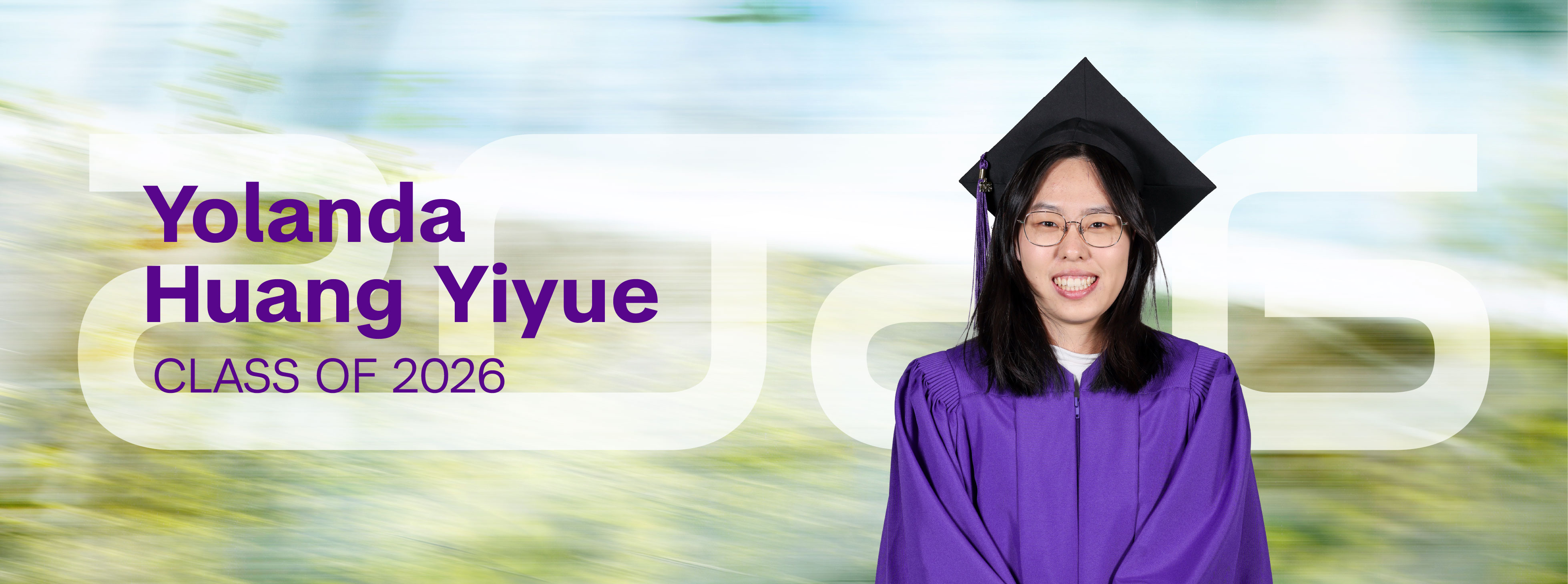
Yolanda Huang Yiyue ’26, a neural science major with minors in physics and mathematics, stood next to her poster. Her research tackled a deceptively simple question: what happens in the brain when people “speak” silently inside their own minds?
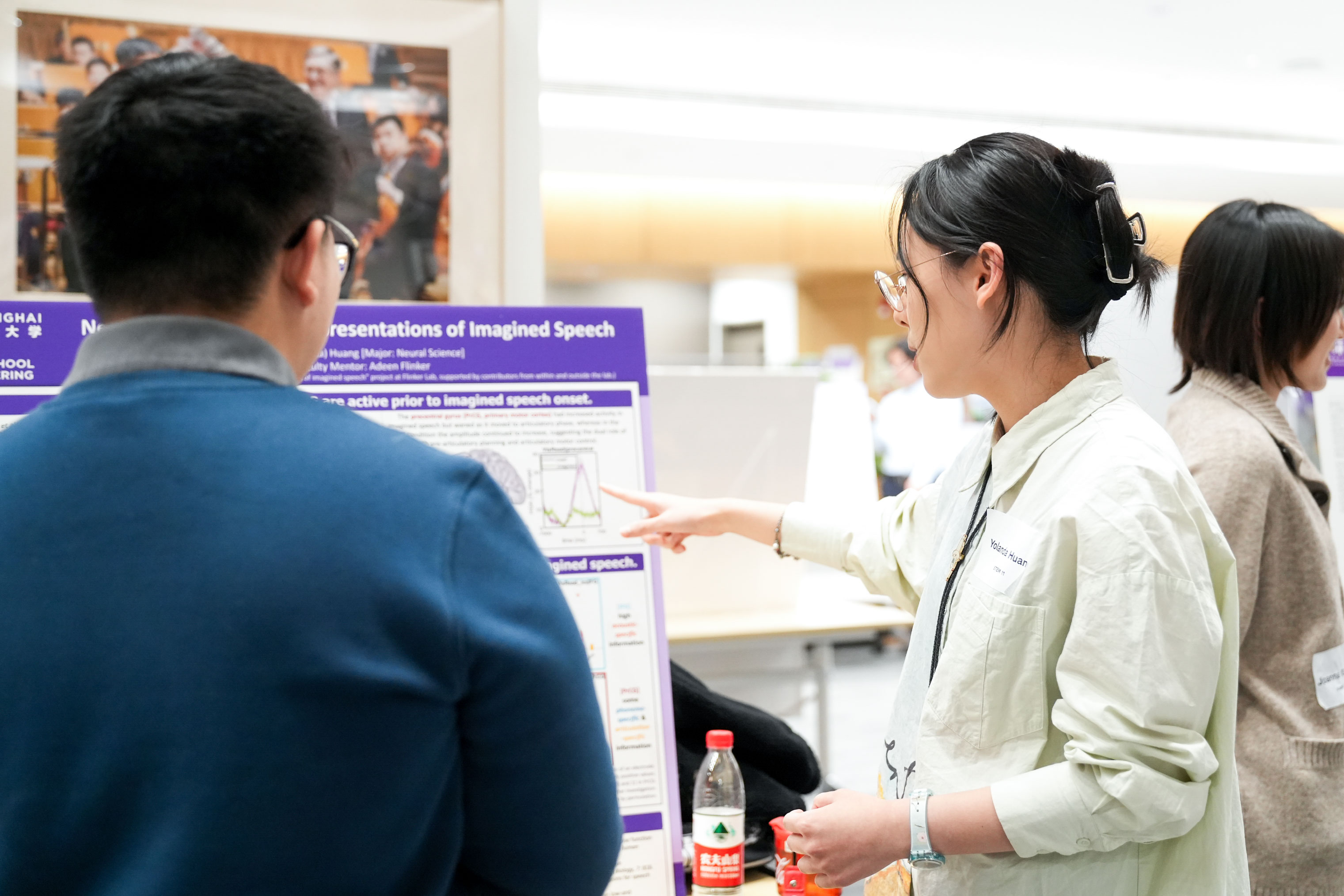
Her project, Neural Dynamics and Representations of Imagined Speech, explored imagined speech — the invisible language running through human thought. By studying language-related activity in non-motor brain regions, Yolanda hoped to understand how the brain processes words never spoken aloud, work that could one day contribute to neural speech prosthetics for patients who can no longer control their orofacial muscles.
She’d come a long way from her struggles to complete her first research proposal as a first year student taking part in NYU Shanghai’s First-Year Fellowship Circle. Feeling overwhelmed, she admitted to Professor of Neuroscience Zhong-Lin Lu that she did not know enough to begin research. His reply stuck with her over the years — research, he told her, is an opportunity to learn.
The inspiration for her research on imagined speech was sparked far from Shanghai during her study-away year at NYU Langone, where she joined the Flinker Lab in October 2024 as a research assistant under the mentorship of PhD student Yu Leyao in the Flinker Lab led by Associate Professor of Neurology Adeen Flinker.
At first, Yolanda handled basic data-processing tasks while senior researchers guided her. In lab meetings, she asked questions freely and gradually grew more confident and independent in her work.
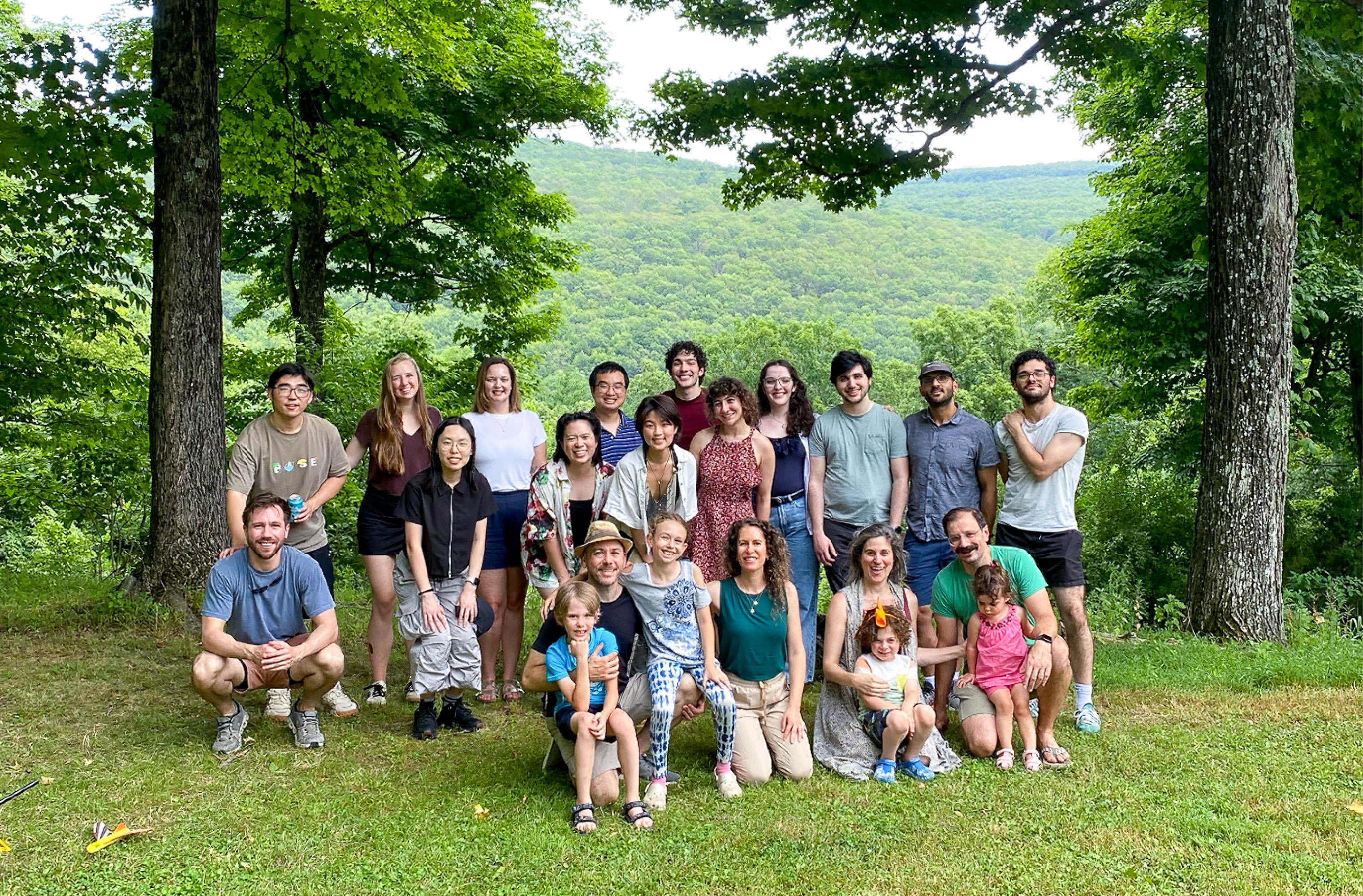
The experience left a huge impact on her, not just for the work she did, but for the feeling of community she gained. While they conducted research, she and her labmates celebrated birthdays, debated Broadway musicals, and visited the countryside together, a quiet pause from the lab. “They didn’t just teach me how to do research,” she remembered. “They became people I genuinely cared about.”
Even after she returned to Shanghai, senior members of the lab helped her rehearse her presentation online. As the symposium approached, she tried to recall their advice, staying up until 3 a.m. to finish her poster and slides just hours before the noon deadline — hunched over her laptop, trimming jargon, rebuilding transitions, and rewriting explanations line by line so her work could be easily understood.
Her hard work paid off — Yolanda received an award for Best Presentation in STEM at the symposium. Soon after, her academic performance and independent research earned her a place in NYU Shanghai’s Neural Science Honors Track, making her the only student in her graduating class selected for the Major Honors Award. At commencement, she will rise through the applause to receive the Dean’s Award in Arts and Sciences.
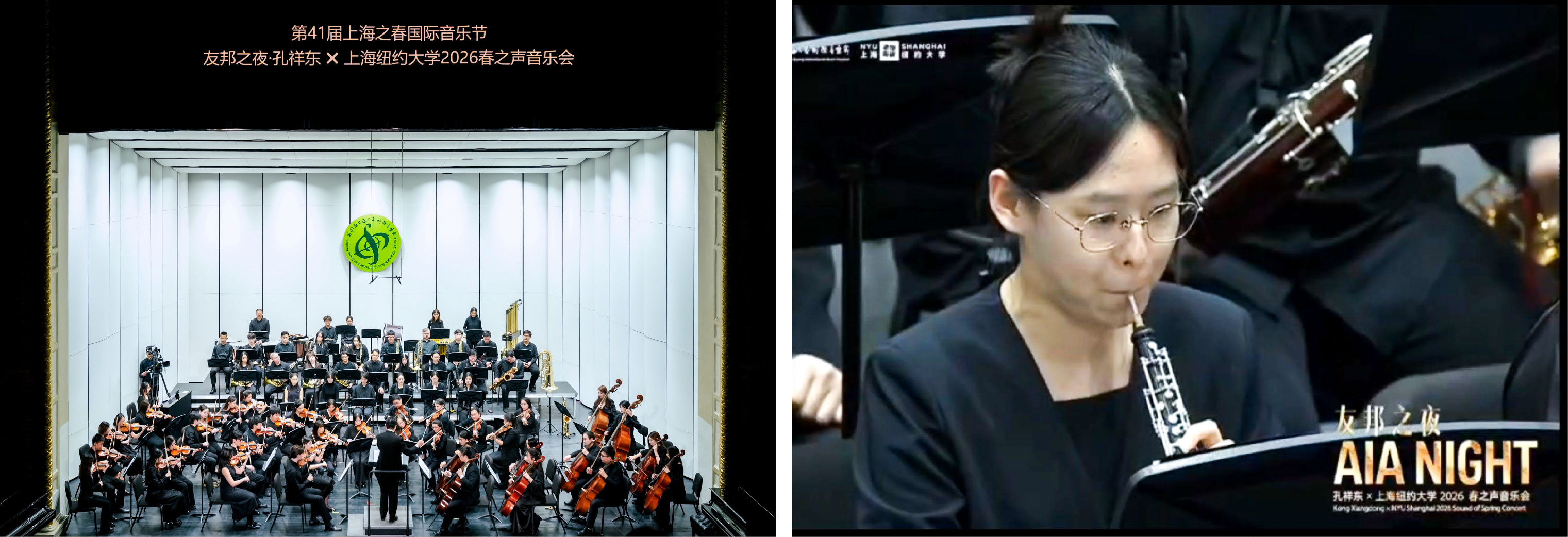
Long before she discovered her passion for neuroscience, music fueled her interests. Growing up in Chengdu, Yolanda began learning the oboe at eleven and gradually fell in love with its warm voice. She especially loved Mozart, whose music felt bright and restless. Her teacher used vivid imagery to guide her. She loved that sudden moment when something abstract finally clicks into place.
In high school, she played in the school wind ensemble, and she found herself wondering how music moves people so deeply. Around the same time, biology classes introduced her to the nervous system — how neurons work and communicate with one another — while beyond the classroom, a quiet curiosity about emotion, movement, and the unseen workings of the mind began to take hold. One idea especially stayed with her: when you study the brain, the brain is studying itself. What began as curiosity gradually grew into a calling.
When it came time to apply for college, NYU Shanghai, one of the first universities in China to offer neural science as an undergraduate major, seemed like a natural choice for her. The more neural science she studied, the more she noticed its ties to physics, especially the electrical nature of neural signaling. Some of her professors came from physics backgrounds themselves, making the connection feel almost inevitable. She added a minor in physics, then another in mathematics.
When Professor of Physics and Mathematics Jun Zhang invited students to visit his lab, Yolanda went out of curiosity and stayed for nearly a year, joining osmosis research. Meetings often spiraled into discussions of mathematical derivations and physics formulas she barely understood. Still, she kept showing up, listening carefully and trusting that understanding would come later.
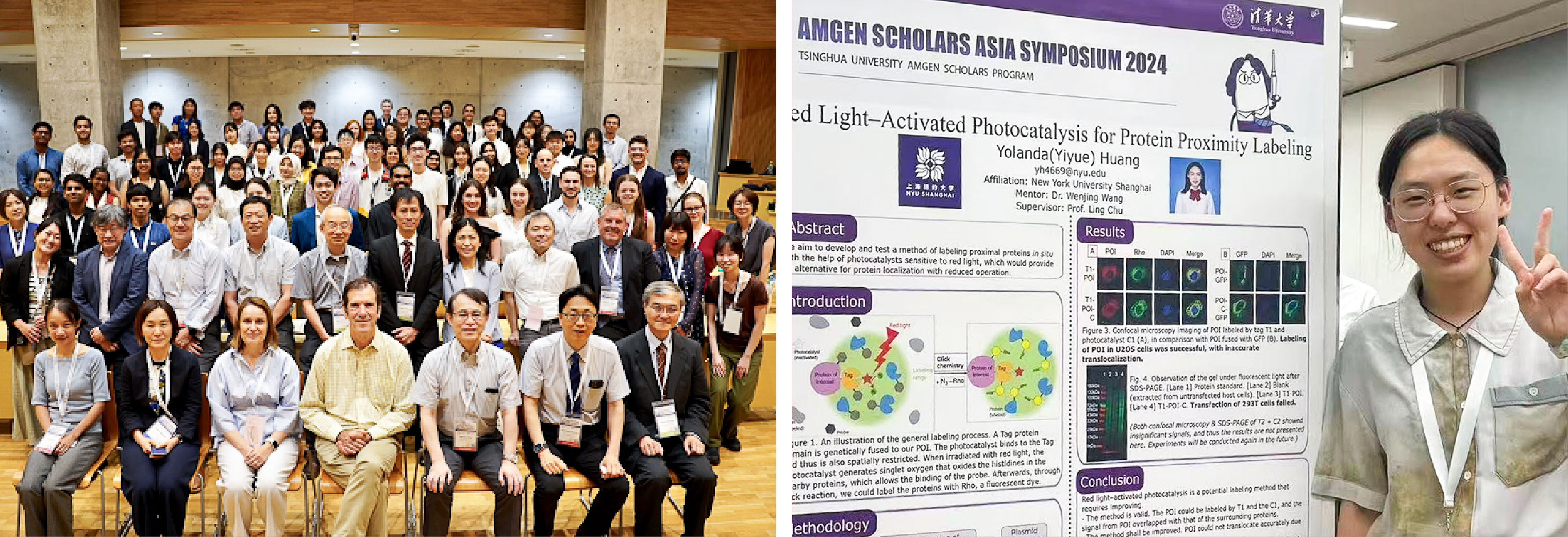
On campus, Yolanda found opportunities outside the lab too. She joined the orchestra almost as soon as she arrived on campus, and weekly rehearsals soon became a steady part of college life. She served as vice president of the Society in Natural Science (SiNS). She was named a 2024 Amgen Scholar and spent a summer doing biomedical research at Tsinghua University’s School of Pharmaceutical Sciences.
As senior year stress began to pile up, with grad school applications and thesis deadlines, life no longer felt fully under control. She briefly considered giving up.
Instead of retreating inward, though, she reached outward — speaking honestly and seeking advice from peers. To her, emotions were not problems to hide but signals to confront directly.
And whenever she needed to breathe again, there was always Disney. In her most anxious, overwhelming week, she visited Shanghai Disney Resort three times. “The moment I get on the subway, my mood starts getting better,” she once said. Sometimes she skipped the rides entirely and simply sat in Treasure Cove until the anxiety eased.
But she never shied away from her emotions. After all, that is part of neural science, too.
Again and again, in her own experiences and those of her friends, she’s noticed how deeply people could feel things they did not know how — or dared — to explain. She wants to understand what happens beneath the surface: how perception of speech and music could leave traces in the brain and body, including eliciting emotions. That curiosity is leading to her growing interest in cognitive neuroscience, a field she hopes to explore further in the future.
In the fall, Yolanda will attend Boston University to pursue a master’s degree in biomedical engineering with a half-tuition scholarship, where she will also join Speech Neuroscience Lab as a research assistant. She hopes to pursue a PhD, push the boundaries of neuroscience research, and eventually build a lab of her own — one as intellectually alive and deeply human as the one that first inspired her.
“As for NYU Shanghai,” she said with a quiet certainty, “within its abundance of academic resources and steadfast support, I found not only the courage to pursue my dreams, but the clarity to see where my story leads next.”