

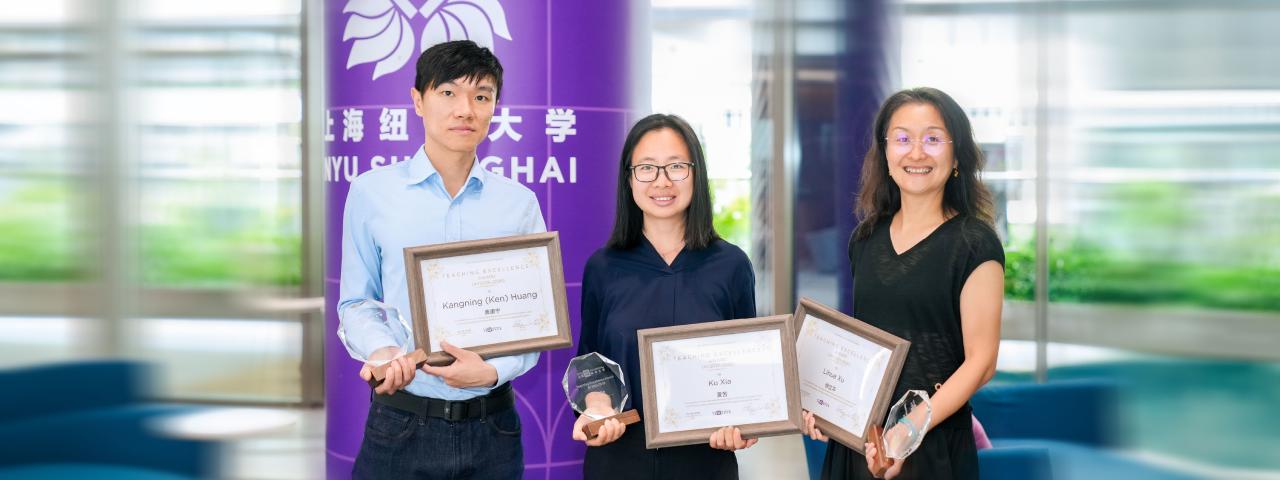
This year’s three Teaching Excellence Award recipients are Assistant Professor of Environmental Studies Huang Kangning, Senior Language Lecturer of Chinese Xia Ku, and Professor of Practice in Computer Science Xu Lihua.
The award committee, in selecting these three educators, recognized distinctive strengths in their teachings: Xu connects complex technical concepts to real-world problems; Huang brings an AI-aware approach to environmental learning; and Xia strikes a rare balance between high standards and genuine connection, keeping students both challenged and supported.
In this age of AI, we asked the three awardees to reflect on what great teachers bring to the classroom that technology cannot.
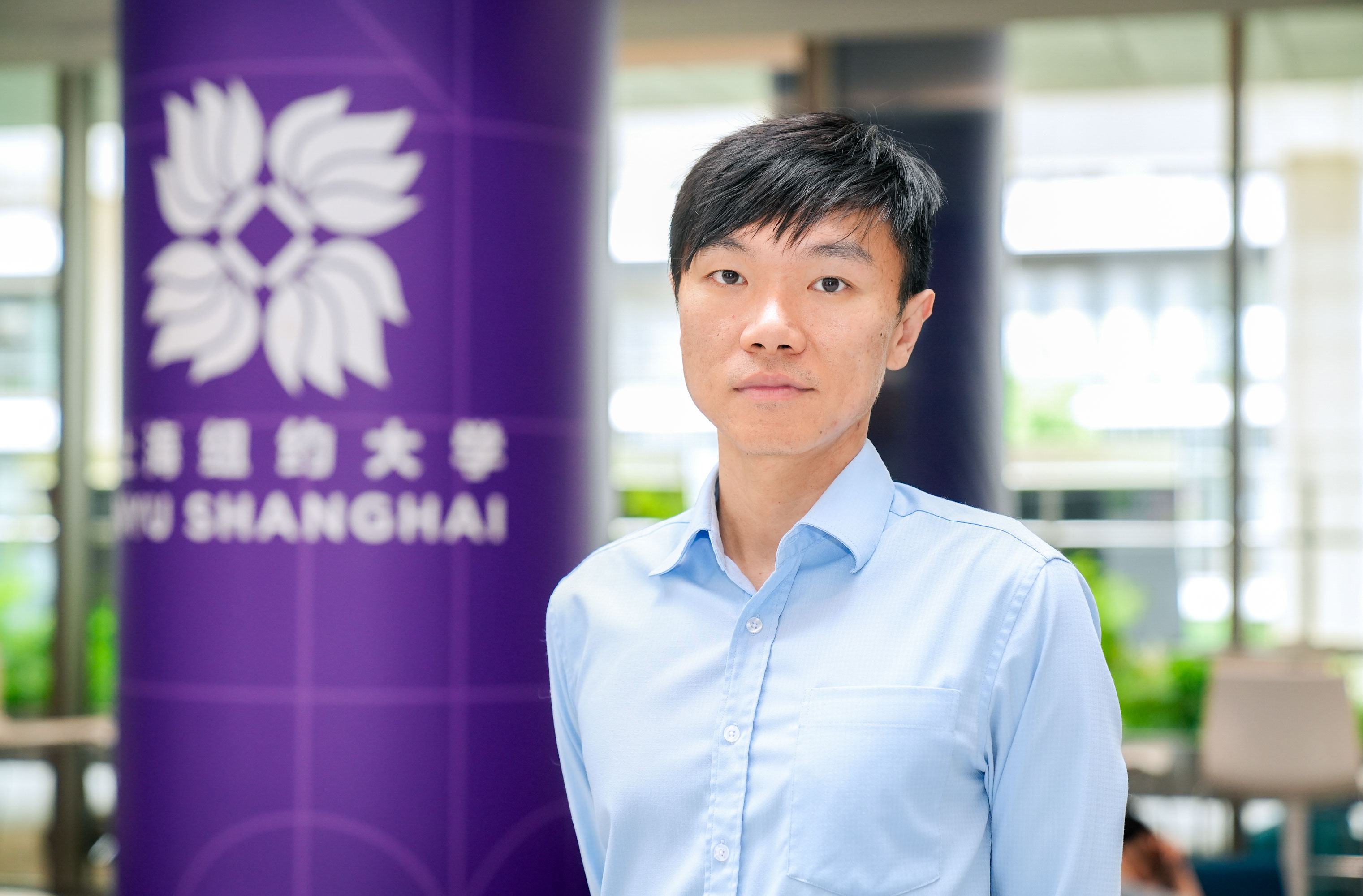
AI Cannot Replace the Human Teacher’s Role in Motivating Students
Some people worry that AI will replace teachers. Are you concerned?
I think there is one thing human teachers can do that AI cannot easily replace: motivation.
In the age of AI, one of the most important things a professor can do is motivate students and create an environment where students motivate each other.
How do you motivate students?
One of the most effective ways is to engage their emotions. You can motivate students through fear, by showing them the risks of climate change. But you can also motivate them through hope, by showing them how new technologies or new ways of designing cities could help solve these problems.
What should students interested in environmental science focus on developing in the age of AI?
Systems thinking and interdisciplinary thinking.Take electric vehicles as an example. You need science to understand carbon emissions and engineering to develop the technology. But getting people to adopt it involves sociology, finance, and economics. AI does not always make these connections on its own. Making connections across distant areas of knowledge still requires human creativity.
If students are using AI, how can teachers tell whether they have actually learned?
In the past two years, I have added oral defenses to my course assessments. After students finish an assignment, I give them about 10 minutes with their devices turned off and ask them about specific parts of their work: Why did you do it this way? How did you get this answer?
Even if AI helped with the assignment, students still have to understand and explain what they produced. If they can, I think the learning goal has been achieved.
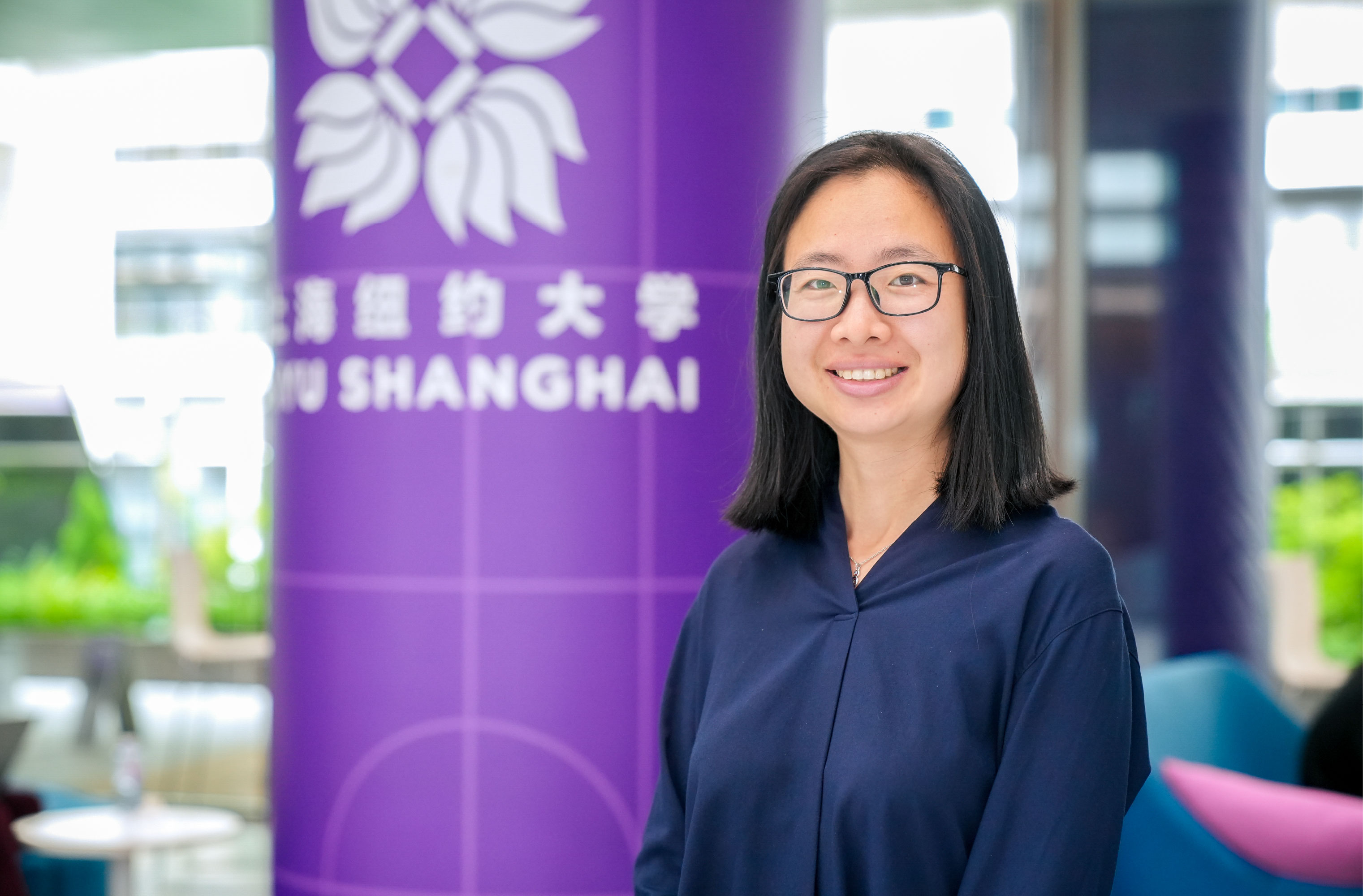
AI Can Translate Language, But It Can’t Replace Real Human Connection
What can a human teacher bring to language learning that AI cannot?
Real-life experience. In elementary Chinese classes, students talk about everyday topics. While they are learning Chinese, they are also getting to know their classmates — their experiences, backgrounds and personalities.
These real-life moments, especially when they come from students’ own experiences, are what they remember. They also make students more willing to use the language both inside and outside the classroom.
How do you guide students in using AI at different stages of language learning?
I think the rule is quite simple: use AI to support your learning, not to replace your own work. If you don't know whether AI is right or wrong, you shouldn't rely on it. What matters in the end is still your ability to use the language yourself.
What do you think makes a good language teacher?
I think how students are doing in the classroom is closely connected to how they are doing outside the classroom. This is especially true for first-year students at NYU Shanghai, who are coming from different countries and entering a completely new environment. Some may feel homesick, and the pace of college can be difficult to adjust to.
One thing that is special about Chinese classes is that we see students four times a week, so we get to know them quite well. A lot of what we talk about is connected to their everyday lives, so students may naturally see their Chinese teacher as someone they can talk to. I may talk to them or send them an email to see if they need any help.
For my students, learning is not only about learning the language. It is also about learning how to deal with challenges. Chinese is not an easy language to learn. I usually talk with students about how they can learn more effectively. I tell them, “This may not work for you. Try it for a few weeks. If it doesn’t work, come back and we’ll find another way.”
I hope they remember not only, “I learned this sentence,” but also that they faced challenges, tried different ways, and found what worked for them. Even if something didn’t work, they learned that they could try again and find another way.
In the end, we’re not just teaching the content of the course, but also teaching life skills beyond the classroom.
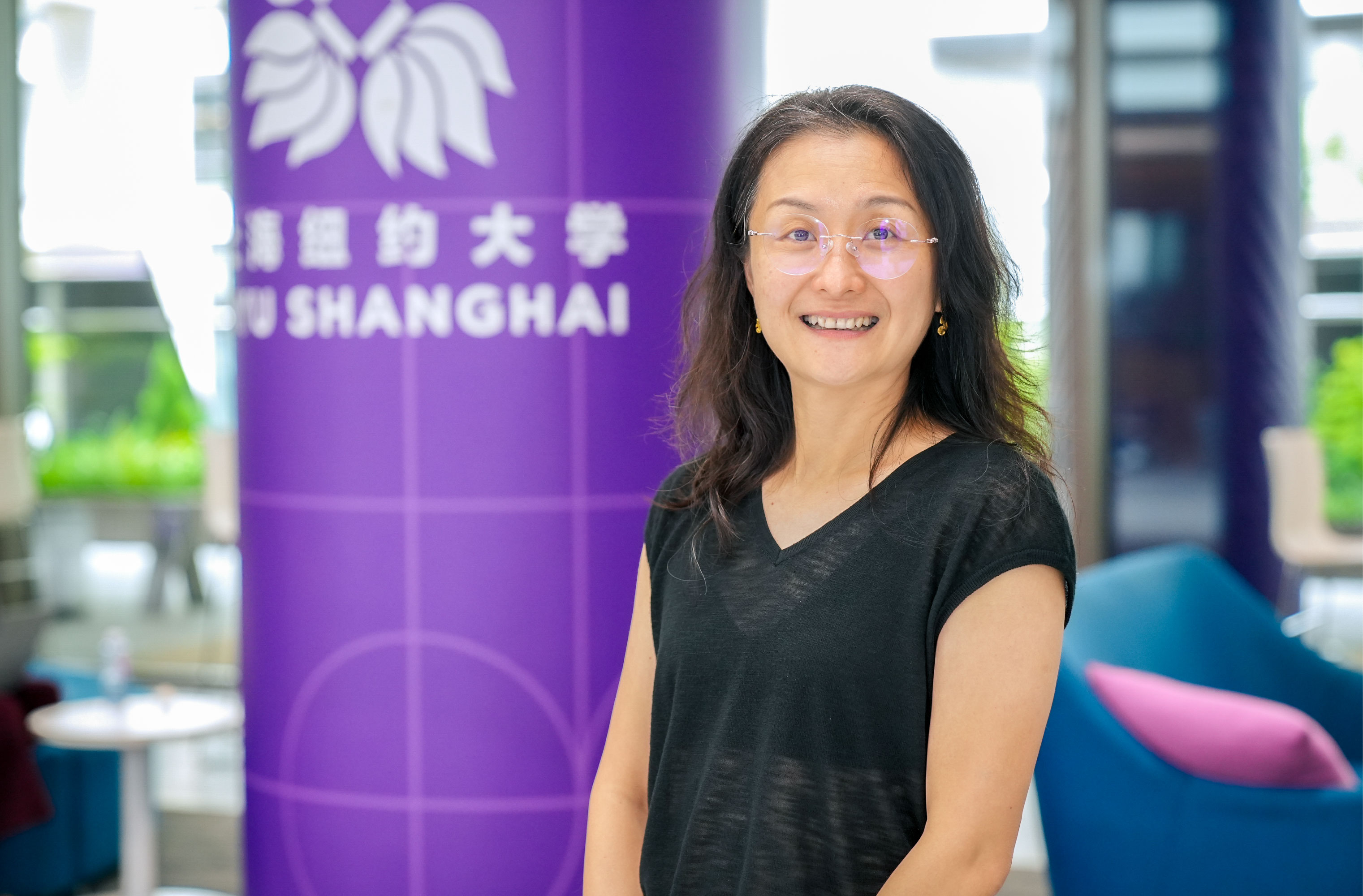
Teaching students to judge, evaluate, and take ownership
How are you preparing students with the mindset they need for the future?
We are focusing on what we call AI-native thinking and competency.
Ownership is at the center. Students need to be able to defend their design decisions and the code they produce. They should understand why they chose one approach over another and what alternatives they have if the context changes. Evaluation is another key part. Students need to know how to build tests around what AI produces. Communication matters, too. Whether they are communicating with AI or with other engineers, they need to communicate clearly and without ambiguity. And finally, students should be able to take what AI produces, improve it, and close the loop.
How do you encourage students to stay curious and motivated to learn?
One thing I find effective is storytelling. I want students to think about where what they are learning might take them in the future. I try to put a concept into a bigger context and show them the problem behind it.
Every technology has a reason why it exists. Database and software engineering concepts came from people trying to solve real problems over many years. Sometimes students ask, “This won’t be on the exam. Why do I need to learn it?” I tell them that what they learn today may not be something they use right away, but it may help them solve a new problem years later.
How do you design your classes so that AI helps students learn rather than simply completing tasks for them?
We have been thinking about this for years, since we first piloted Kiwi, NYU Shanghai’s generative AI learning platform, in Introduction to Computer Programming (ICP). Our principle is simple: AI should guide, not replace.
Professor Wen Hongyi’s team designed Kiwi so that it does not simply give students the answer when they get stuck. Instead, it offers step-by-step hints that help them identify the problem and arrive at a solution themselves.
Kiwi enables personalized learning at scale. Based on students’ interactions, it identifies areas where they need more support and generates targeted follow-up exercises.
We have changed how we assess learning. Rather than evaluating only whether the final code works, Kiwi also considers students’ reasoning, revision process, and understanding of key concepts. Simply submitting AI-generated code is not enough.
In the AI era, the key question for teaching is: Which parts of a task can we give to machines, and which parts are themselves the learning process and must remain with the student?