

This spring, NYU Shanghai launched the second offering of its Open Courses non-degree program bringing short-term continuing education opportunities to adult lifelong learners in the general public. The course - Parenting in Contemporary China - created a space for participants to examine a subject that is both deeply personal and widely shared: how children are raised in today’s China, and how family life is evolving alongside broader social change. The program encouraged participants to look beyond the pressures and routines of daily caregiving and consider parenting through a wider lens shaped by research and reflection.
Taking place from April 11 through June 6 and taught by NYU Shanghai Associate Professor of Psychology Cui Lixian, the course spoke to a reality many families recognize. Raising children today can feel more complicated than ever, with ever-increasing expectations of academic achievement, rapid technological change, shifting ideas about what it means to be a “good parent,” and more varied family care arrangements. Rather than promising quick answers, the course helped participants make sense of these pressures and better understand how everyday interactions at home can influence children’s growth over time.
A highly engaged and diverse cohort of 36 participants made up the total enrollment, averaging 13 years of work experience and ranging in age from their early 20s to early 50s. Participants also represented a wide array of industry backgrounds, from education, fashion, health care, manufacturing, consulting, finance, international trade, publishing, arts, media, logistics, among others. Finally, more than ¾ of participants reported the course as being their first significant connection to NYU Shanghai, furthering the inclusive ethos of the Open Courses program as a highly accessible introduction point to a NYU Shanghai education.
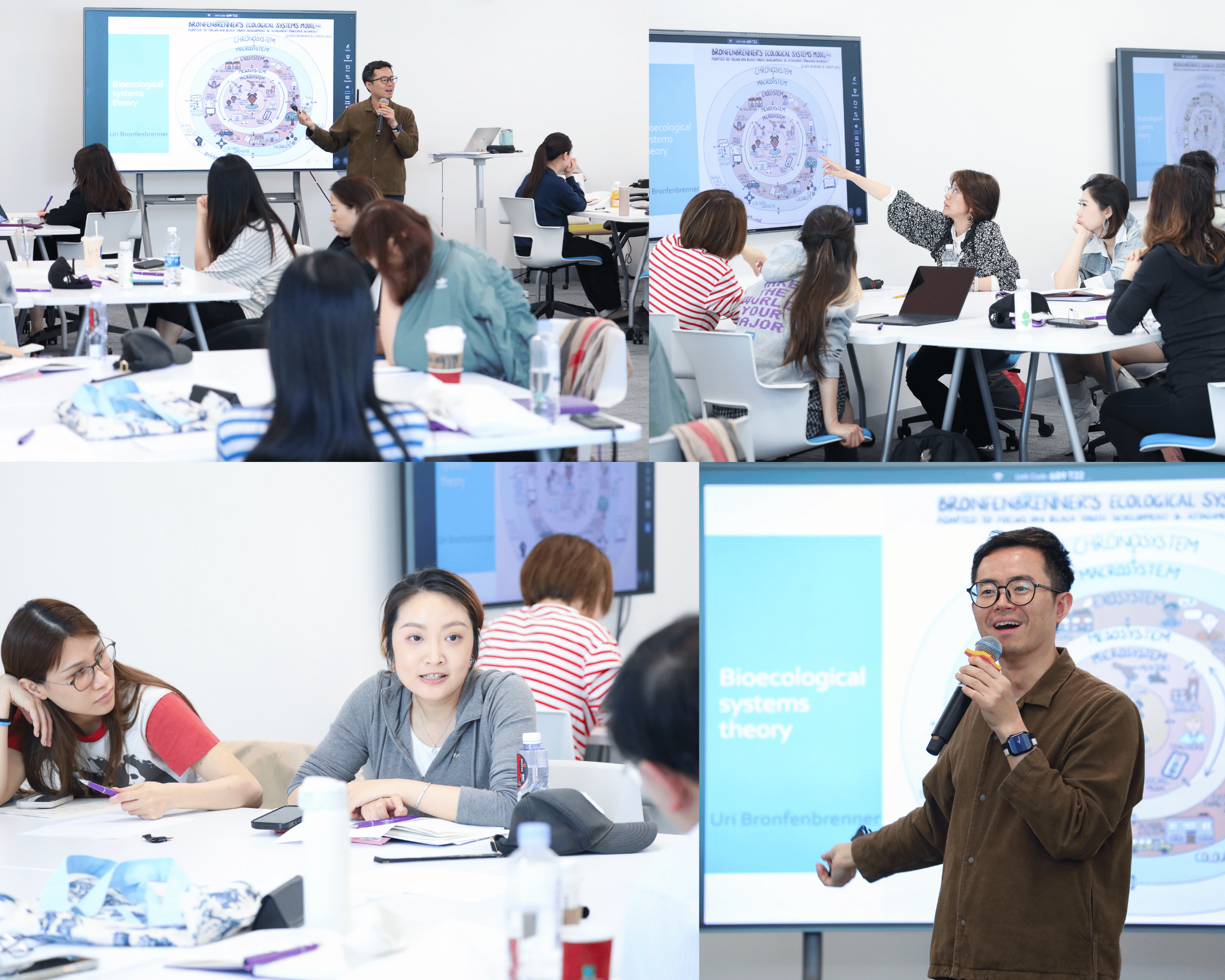
Over 24 instructional hours in the core Section 1 lecture module, the course drew attention to the many forces that shape childhood from the early years through adolescence. Professor Cui illuminated long-standing questions related to discipline, emotional bonds, and parental authority, while also considering how these questions take on new meaning in contemporary China. Topics also included intergenerational caregiving, expectations placed on sons and daughters, highly competitive educational environments, and the cultural ideals that continue to influence how families define success and responsibility.
In the optional 6-hour Section 2 seminar module which featured a smaller, discussion-focused environment, participants engaged in peer-to-peer dialogues moderated by Professor Cui that aimed to connect themes from Section 1 even stronger to actual lived experiences. Across these conversations, the emphasis remained on not producing a single model of “correct” parenting, but to equip participants with a stronger framework for understanding children, caregivers, and the relationships between them.
As Professor Cui reflected:“It was deeply rewarding and truly inspiring to explore parenting in contemporary China with such an engaged and energetic group of participants. From parents and kindergarten teachers to educational leaders, each brought unique experiences and inspiring stories that made our conversations truly meaningful. The classroom buzzed with warmth, curiosity, and thoughtful exchanges throughout the course.”
NYU Shanghai extends its congratulations to all of the participants who completed the Parenting in Contemporary China course this Spring and welcomes lifelong learners of all ages who are interested in joining our continuing education community. NYU Shanghai looks forward to the launch of many more new offerings in the Open Courses program, including the next course in the series, Understanding Our World Through Food, which will begin on August 1 and is currently accepting enrollments through July 27.
Participants In Their Own Words
Hu Jiayuan
Education Content Creator
Although Professor Cui's course at NYU Shanghai consisted of only six sessions, it left me with a profound sense of clarity and insight. Grounded in the realities of today's social environment and the principles of child psychology, the course systematically unpacked common parenting pitfalls in modern families and offered practical, well-grounded strategies for addressing them.
At its core, parenting is about respect and presence—not measuring children against a single, uniform standard. In just six sessions, my entire framework for thinking about parenting was reshaped, and I learned to approach my child's world with greater empathy and openness. As someone who creates content related to education topics, I hope to pass on what I've learned to more parents, in the hope of easing the parenting anxiety so many families share today.
Chen Hanbo
Full-time Mother
As a mother who transitioned from a career to staying at home full-time, I signed up for this course on parenting psychology mainly to fill in the gaps in my knowledge. Over the course of nearly two months, Professor Cui's teaching style made me feel very much at ease—he was able to convey parenting theories in the simplest, most down-to-earth language, allowing me to absorb a great deal of practical knowledge in a relaxed environment. It has been deeply inspiring for both my outlook on life and my parenting journey.
Zhao Yuanru
Founder, Study Abroad Consulting Studio
In my work, I meet many families navigating study-abroad plans, and most struggle, to some degree, with parent-child conflict or anxiety over their children's academic path. This was my main reason for taking the course.
Three takeaways stood out. First, the lecture-plus-seminar format brought back the feeling of being a student again, and reminded me of the value of lifelong learning. Second, Professor Cui's theories—such as the distinction between "orchid children" and "dandelion children," each requiring different approaches to communication—deepened my understanding of parent-child education and how to bridge communication between the two. Third, I met many peers in the field, from teachers, consultants to parents, which pushed me beyond my own small world and helped refresh my thinking.
Finally, a word for parents: give your children a little more room to explore and make mistakes. That may be how they find their own place in the world.
Daisy
K12 School Teacher
My biggest takeaway was how happy I felt to be in such an inclusive environment, sharing cases with classmates from such different fields and backgrounds. This process gave me many perspectives I hadn't encountered in my own work, and gave me a new understanding of the relationship between parents and children—this was the part I gained the most from.
In my work at school, my perspective mostly comes from interacting with students, or communicating with parents in my capacity as a teacher. But through the discussions in this course, I was able to understand, from a much more genuine, first-person perspective, what parents and children actually think in real life, and what problems they're really facing behind the scenes. This helps me better understand the signals students show at school, and helps me do a better job of supporting them in my work.
Qing Lin
Corporate Manager and Community Volunteer
I'm currently a semi-stay-at-home parent living in Qiantan, which is how I came to learn about this course.
I have a son in middle school, and since he entered adolescence, our parent-child relationship and the overall atmosphere at home have grown increasingly challenging. My biggest question going in was: how do you connect with a teenager, and what does it really mean to be a good parent?
Both parts of the course were deeply inspiring. The first part involved learning the professor's material and related social research together with the whole class; the second was a small-group setting, where a few of us went deeper into specific topics under the professor's guidance. What stood out most was the final session of the second part, where the professor shared new developments and practices in the field of education, giving us a much more comprehensive view. My biggest takeaway was this: look at your child through the lens of growth and development, and trust that children are capable of changing and learning.
Guo Meirong
Mentor in Adolescent Parenting and Growth Planning
I hold a doctoral degree and am the mother of two teenagers. I now work as a family education consultant, and I have raised both my children myself, with great care for their development. When I came across this course at NYU Shanghai, I was drawn to it immediately, hoping systematic study could help me grow further in my own practice.
Professor Cui's course truly integrates advanced theory and research from both China and abroad. The first part covered parenting itself—parent-child relationships, emotional guidance, and the often-overlooked task of building family systems. The second part consisted of peer discussions among classmates from a wide range of backgrounds, each bringing a different perspective.
This course gave me much greater confidence in my own counseling framework. Much of my consulting work today is "firefighting"—people tend to seek help only once a problem has emerged. This course strengthened my commitment to shifting that reactive approach toward more forward-looking, preventive parenting. I'm very grateful to Professor Cui for such an excellent course, and to NYU Shanghai for providing such a valuable platform for learning.
About NYU Shanghai Non-Degree Programs
NYU Shanghai non-degree programs extend the opportunity of a NYU Shanghai education to lifelong learners, corporate enterprises, and organizations across sectors seeking to acquire skills and knowledge, unlock growth, and join our international community of students and scholars. From executive education to custom training, professional certificates to open-enrollment classes, all of our programs combine academic teaching with applied relevance, multidisciplinary experience, global perspective, and connectedness to NYU’s global network.
For more information about non-degree programs at NYU Shanghai, visit the Office of Non-Degree Programs (ONDP) website or contact the ONDP at shanghai.nondegree@nyu.edu.