

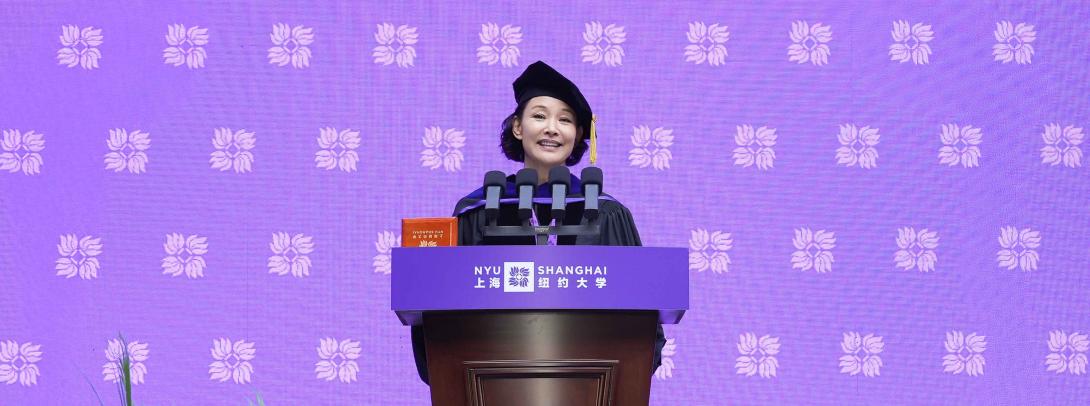
University leadership, distinguished guests, and the Class of 2026—congratulations on this remarkable achievement.
It is a great honor and pleasure for me to celebrate this special day with you.
What can I say to you? I suspect many of you are already far better prepared than I was at your age—at least in terms of knowledge and opportunity. And I trust that, if you have not already found it, you will in time discover your own sense of purpose and meaning.
I have lived a long life, and I still cannot claim to have found any ultimate answer or truth. Like most people, I continue to live the questions, as Rilke wrote in Letters to a Young Poet.
A couple of months ago, I was asked to provide a short bio for the commencement announcement. I’ve done this many times before for different organizations. And each time, as I arrange the words, I feel as if they are describing someone else. Everything it says is true—yet what genuinely matters always seems to be missing.
So today, I would like to share with you something of that invisible, warm interior that forms my core.
At the age of fourteen, I was picked from my high school rifle team to play a girl soldier in a film called Jing Gang Shan at the Shanghai Film Studio.
Though I had little formal education, I had a deep thirst for reading. At the time, most literary works were banned, and books were scarce. But my maternal grandmother had kept a secret stash of books in the attic. She would let me borrow one on my sick days. Nose stuffed, chest congested, throat burning—I lived more fully in those moments than at any other time in my childhood.
In those years, people couldn’t travel freely. Yet at fifteen, I was lucky enough to be sent on location to Huangshan for the film Youth. It was the first time I truly experienced nature.
The granite spires rising out of a sea of clouds.
The pines sculpted by centuries of wind.
The steep stone steps along which our daily provisions were carried up the mountain.
Around that age, the word “God” entered my vocabulary. And its meaning revealed itself to me—not through religion, but through the ever-changing light, shadow, and color of the Yellow Mountain.
Looking back, the hunger for books and the encounter with nature in my formative years have sustained me throughout my life—through both the good times and the desperate ones, especially the desperate ones. In those depths, reading always brought a sliver of light that restored my faith, and nature my sense of awe.
From my early twenties to my mid-thirties, I read almost indiscriminately—Whitman, Blake, Rilke, Hesse, D. H. Lawrence, Anaïs Nin, Naipaul, Márquez, Llosa—writers that many in the West take for granted, but whom I had never encountered before.
There was a period when I was deeply immersed in Milan Kundera, who gave language to experiences I had felt but could not articulate. Later, I discovered Raymond Chandler and Dashiell Hammett through a film noir class and fell into detective novels with equal passion.
I am by nature a loner. And I found communion with authors—many of them long gone from this world—deeply rewarding, and healing.
Numerous times in my life, when failure felt too heavy to bear, I opened Whitman's Leaves of Grass, and met a voice that understood defeat…without shame.
It says:
"I am an old artillerist… I tell of my fort’s bombardment—
I am there again.
Again the attacking cannon…the smoke…the volleys.
I see the gaps cut by the enemy’s fire—
quickly filled…no delay.
I breathe the suffocating smoke…
and yet—
the defeat is honorable."
……
"Battles are lost in the same spirit in which they are won.
I beat and pound for the dead;
I raise my horn and play my loudest and gayest for them.
Vivas to those who have fail’d!
And to those whose war-vessels sank in the sea!
And to those themselves who sank in the sea!
And to all generals that lost engagements, and all overcome heroes!
And the numberless unknown heroes equal to the greatest heroes known!”
In this equation of victory and defeat, I found my dignity and courage affirmed, my wounds salved, and my soul expanded.
To borrow from Rebecca Solnit:
“I disappeared into books… like someone running into the woods.”
And speaking of running into the woods, let me return to the topic of nature. That phrase is equally true of the real world, where you look at a shimmering sunset, filtered through tall trees, and feel stilled—at one with the universe.
In 1988, I spent a month in the Australian desert filming The Blood of Heroes. Much of that distant memory has faded, but I can still see the luminous Milky Way, the faint outline of dunes, the distant rock formations.
And the mussel fossils I picked up—and then lost. They had lain untouched under desert shrubs, which had earlier been the bottom of the sea, for hundreds of millions of years, before my hand found them. I was awestruck by the mystery of the universe.
I can’t quite define what happiness is. But when I was learning French for my latest film, Montréal, My Beautiful, I came across the French word for happiness: bonheur. “Bon” means good, and “heur” means hour. Native speakers may not think of it this way, but I couldn’t help believing that happiness might simply be “a good hour.”
A good hour feels attainable.
Perhaps those wonder-struck hours under the Southern sky are happiness.
Or the quiet hours spent reading a book.
I once read that happiness is to be dissolved into something complete and great—and that when it comes, it comes as naturally as sleep.
That is how I have felt, at times—reading a book, or standing beneath a vast sky: dissolved into something larger than myself.
Each of you will discover your own definition of happiness.
Do not let anyone else define it for you.
Your true essence is not your résumé, but the secret, untouchable, crystallized inner life that only you can know.
Tomorrow, you will leave this comfortable cocoon and enter a chaotic world. You will become, officially, adults. But please—forever keep and nurture the curious child within you.
Continue to experience the small miracles around you with a child’s sense of wonder—whether it is a golden beetle, a pink cloud, a blue butterfly, a book, or anything that feels miraculous to you.
Stay open to the epiphanies these moments bring.
I may sound presumptuous, but I imagine few of you will need to worry about your next meal. That kind of hardship, in a way, offers clarity. What you may face instead is something more diffuse: a kind of existential anxiety in a world driven by endless desire.
It becomes all the more important, then, to find what enchants you—what sustains you spiritually—what allows you to merge with your destiny.
And finally, dear young people—fall in love. With the sun and the moon, with rivers and fish, with mountains and animals. With another human being. Intensely. Deeply. Again and again. Despite what you may hear on the internet.
Personally, I have found that the vulnerability, humility, heartbreak, and rapture that love brings are among the most authentic and transformative experiences life can offer. Those moments of luminous intensity remain in my memory like stars—vivid and enduring—while the stretches of time between them dissolve into a soft and distant haze.
I’ll leave you with a passage from The Painted Drum by Louise Erdrich:
"Life will break you. Nobody can protect you from that, and living alone won’t either, for solitude will also break you with its yearning. You have to love. You have to feel. It is the reason you are here on earth. You are here to risk your heart. You are here to be swallowed up. And when it happens that you are broken, or betrayed, or left, or hurt, or death brushes near, let yourself sit by an apple tree and listen to the apples falling all around you in heaps, wasting their sweetness. Tell yourself that you tasted as many as you could."
Thank you—and congratulations.