

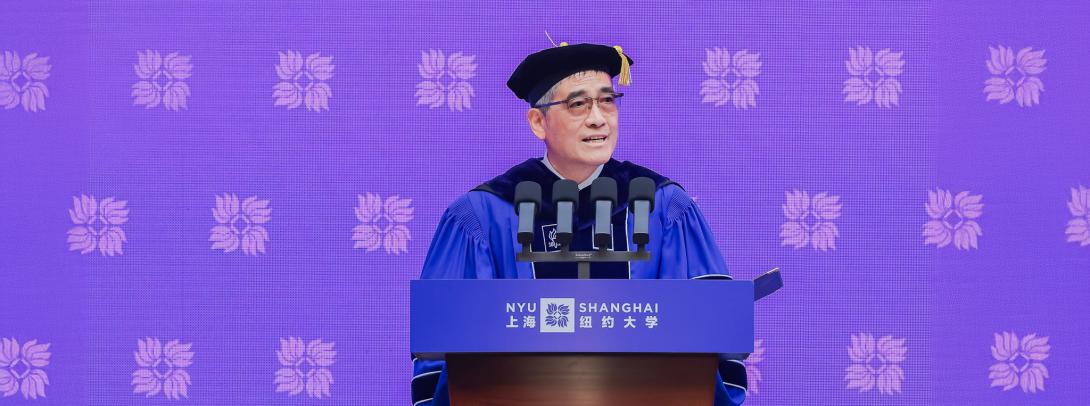
Dear graduates, parents, colleagues, friends, and distinguished guests,
Today we gather to celebrate a class that holds a very special place in the history of the NYU Shanghai community. Every graduating class is unique, but the Class of 2026—you are unique in your own distinct ways. For one thing: you are the cohort of NYU students who graduate in the same year when NASA of the USA accomplished its glorious Artemis II mission.
Like China’s Chang’e-6 mission in 2024, which retrieved samples from the far side of the Moon, the four astronauts of the Artemis team, by flying around the Moon, dramatically realized the human dream of personally knowing the “other side” of the Moon. As you likely know, as a result of the phenomenon called “tidal locking,” from the moment our ancestors first turned their eyes to the sky, we people on Earth could only see “this side” of our closest celestial neighbor, or the side of the moon that is always facing us.
The point I want to make by referring to these efforts to reach the far side of the moon is that, while human beings are defined by how they learn, the most important way for humans to learn is to go beyond their own side of any issue. The 19th-century British thinker John Stuart Mill once said that whoever knows only their own side of the case knows little of that. As the 2026 cohort of NYU Shanghai graduates, my dear students, you have learned Mill’s lesson not only from books, but from life itself.
You have experienced NYU Shanghai both before and after its move from Century Avenue to the New Bund campus here in Qiantan; you have come of age from before to after the global pandemic; and you have studied both before and after the sudden emergence of large language models in our everyday lives.
Personal experience, when reflected upon seriously, is surely one of the deepest ways of learning. But personal experience also has limits. You are natives of the smartphone age, for example, so you do not probably remember clearly what it meant to live before the smartphone became an extension of the body. You are also natives of an age of geopolitical tension, so you did not fully experience the time when the world was felt to be “flat” without being “deep” at the same time.
This is not your fault. Every generation is born into a world already underway, and our personal experience is always limited. That’s why we need what we call “education,” which does not only mean “learning,” but also mean “organized learning.”
In my view, the university will always be an essential human institution. Even when AI gives us ever more access to more sides of the universe, it is only in universities that one can experience the highest level of organized learning processes —learning processes that are guided, disciplined, inspired, and shared.
With learning “both sides” as the aim of education, I hope you have personally experienced the unique advantages of NYU Shanghai. As a school jointly sponsored by two great nations and located in a great metropolitan city, NYU Shanghai is designed to offer you special help in seeing “both sides” of those essential aspects that define our personal, national, and cultural identities.
Yet from today on, this structured help will end—or at most be available in different ways. As you graduate, the responsibility for seeing both sides of any issue becomes increasingly your own. From this day forward, nobody but yourself would frequently remind you never to be satisfied with just the "here and now.”
Let me end with a small story.
Early this month, while watching a TV program in a hotel in Oslo, I learnt that in Nigeria, a woman’s bride price must include a bicycle: “No bike, no marriage.” Two days later, at a dinner organized by the Norwegian Academy, I happened to sit next to a scientist who originated from Nigeria. I asked him about the connection between bicycles and marriage in his country. He smiled and said he had never heard of such a thing. Perhaps, he suggested, it might be true in one small local community, but certainly not in Nigeria as a whole.
I learned a lesson at that moment. After completing your studies at NYU Shanghai, you have learned a great deal — about Shanghai, about China, and about the world. But some of what you think you know may still be like that piece of news: interesting, memorable, perhaps not entirely false—but incomplete, and in need of further testing.
So, dear graduates, leave this campus with confidence, but also with humility. Carry with you what you have learned here, but keep it open to correction, expansion, and transformation elsewhere. Let your future experiences — what you will learn from the “other side” of an issue — verify, supplement, and elevate your knowledge acquired at any particular moment.
Once again congratulations Class of 2026.