

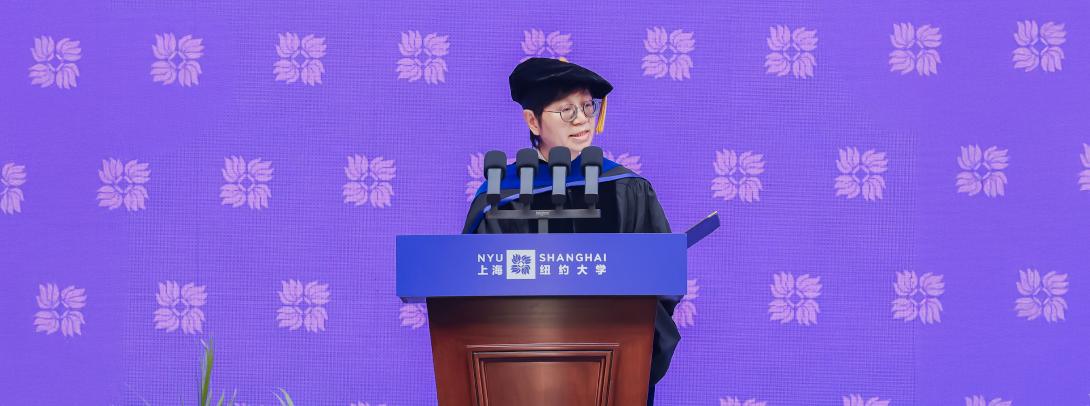
Class of 2026, Colleagues, families and friends — good afternoon. There are over 600 students in this courtyard, from 46 countries and regions, holding degrees in everything from neural science to interactive media arts, from computer science to business and finance. I have been told the only thing you reliably have in common is that every single one of you chose this — chose to come here, of all the places in the world you could have gone. I want to say, on behalf of the university: thank you for that choice. We are better because you made it.
As I stand here for the first time as your provost, I feel a deep kinship with you. In a way, we are both "starters" today. You are starting your lives as alumni; I am starting my tradition here with you. That word — start — is also what brings me to the rest of what I want to say. My work has nothing to do with beginnings. I am a gerontologist. I spend my professional life at the other end of the age spectrum, studying how people live a long time. When friends learn this, they always ask the same question: what is the secret? They expect me to say vitamins, or exercise, or good genes.
It isn't any of those.
After thirty years of looking, I can tell you the people who live longest tend to share three qualities. They can take a hit and stay standing. They can change when the ground changes. And, even after the first two have been tested for decades, they still believe tomorrow is worth showing up for. Resilience. Adaptability. Hope. I want to talk about each one, through a single person.
A few years ago I sat across from a woman I’ll call Mrs. Wang. She was 103. By the time I met her, she had buried a husband, two siblings, and three of her own children. She had lived through a war, a revolution, and the rise and fall of three different currencies in her own pocket. The neighborhood she lived in for four decades was demolished. The language her grandchildren now speak at home is not the one she taught her children.
By any reasonable measure, the world Mrs. Wang was born into no longer exists. She outlived it. She is, all by herself, a lesson in all three.
Start with resilience. Resilience isn’t what we usually pretend it is. It isn’t gritting your teeth and refusing to feel the blow. Mrs. Wang felt every loss; she could name each one, in order, with the years. Resilience is something more biological than that, and my field has a word for it. Hormesis. It is the reason a muscle you tore on Monday is stronger on Friday. A low dose of stress — the right dose — doesn’t damage an organism; it trains it. Your bones thicken under load. Your immune system learns from exposure. Your mind grows from problems it could not solve last year.
The Chinese proverb gets there first: 失败乃成功之母. Failure is the mother of success. It is not a consolation. It is a description of how living things get stronger.
So when I tell you that you will fail at things in the next ten years, I am not warning you. I am explaining the mechanism. The people who do something interesting with their lives are the ones who attempt things they cannot yet do, and the failures along the way are not detours from the work; they are the work. If your next decade is perfectly smooth, something has gone wrong. You will have stopped lifting the weight.
But surviving hits is only half of it, and the longevity data is stubborn on this point. The people who endure but refuse to change — who keep insisting on the world as it was — do not live especially long, and they do not live especially well. The ones who last are the ones who can let an old version of themselves go.
Mrs. Wang ran a shop, then worked in a state factory, then raised grandchildren, then — in her nineties — taught herself to use a smartphone so she could see those grandchildren’s faces when they moved abroad. She did not love every one of those transitions. She did not have to. She simply refused to be the person who couldn’t.
This is where your education has given you an unusual head start. You chose a degree at the seam between two worlds. You have moved between languages, between time zones, between ways of seeing. You have learned that the version of yourself who works in one room is not always the right version for the next room — and you have learned to translate. Not just words. Yourself. The decades ahead will not stand still long enough for anyone to master them. The people who do well will be the ones who can keep updating without losing themselves in the update. You already know how.
Which brings me to the third quality, hope, and the one I find most moving in my work.
I asked Mrs. Wang, near the end of our conversation, what had actually kept her going. Not the biology of it — the daily reason. She thought for a long moment and said: “I got curious about what would happen next.”
I want you to hear that carefully, because it is not what we usually mean by optimism. Optimism, the way we use the word, sounds like a personality trait — some people have it, some people don’t, and the ones who have it had an easier life. That is not what I see in our oldest populations. The people I study are not optimists because life was kind to them. Many of them have grieved more than you and I will ever have to. They are optimists because, after everything, they decided to remain interested in the next chapter. Hope, in this sense, is not a feeling you wait to arrive. It is a discipline. It is what you do on the days when nothing in your circumstances has earned it yet.
Find what makes you lean forward. Protect it. The data is unsentimental on this: the people who live longest are the people who have a reason to wake up. A craft, a question, a person, a cause. It doesn’t have to be grand. Mrs. Wang’s reason, at 103, was a great-granddaughter learning piano. That was enough.
Resilience lets you take the hit. Adaptability lets you become the next version of yourself. But it is hope — the stubborn, unfashionable, almost biological insistence that tomorrow is worth seeing — that decides whether you actually use the other two. You can be tough and flexible and still go home. Hope is what keeps you in the game.
So three things, and I’ll sit down.
- Take the hit. Hormesis is real. The thing that knocks you down this year is, if you let it, the thing that makes you stronger by next.
- Let the old version go. The you who graduates today is not the you who will be useful in 20 years. Be willing to become the next one.
- Stay curious about what happens next. That is what hope actually looks like. And remember — your failures are not your identity. They are your tuition.
Class of 2026 — congratulations. I am proud of you. Go find out what happens next.