

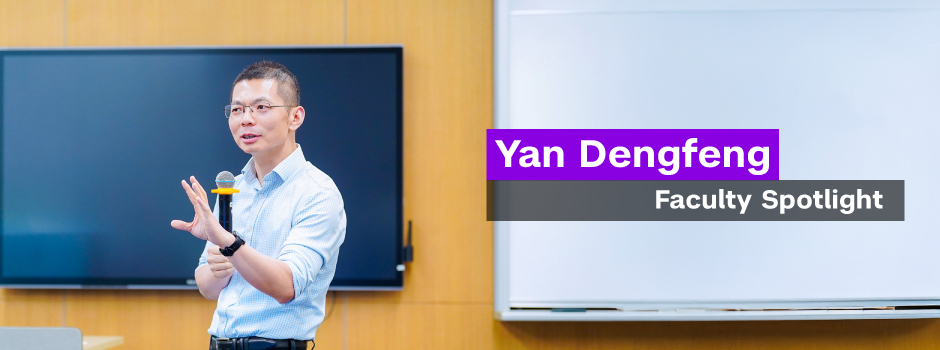
Associate Professor of Marketing Yan Dengfeng’s path may seem unconventional to some, but his focus has remained understanding how consumers think and act. Whether in his classroom or in his studies, Yan embodies a simple belief: the most meaningful research begins and ends with people.
You studied Political Science as an undergraduate. How did that experience shape your later research and what drew you to marketing and consumer behavior?
Political Science wasn’t my first choice. Looking back, it turned out to be a meaningful detour though, as it trained me to understand people and society from a macro perspective, for instance, how institutions shape people’s behaviors, and how policies influence people’s lives. It expanded my perspective to public policies and urban governance.
What first drew me into Marketing was the concept of branding. A brand not only influences individuals but also has a profound impact on cities and public image. Questions like how a city can capture attention through branding, how can public policies be designed to encourage residents to participate. These are the areas where concepts of marketing can be applied. You can tell how political science and marketing are similar and connected.
Marketing is about studying human behaviors, which involves psychology, economics, and public policy. Good research to me is not defined by discipline.
Early in your career, you worked as a journalist. What impact did it have on your career path?
After college, I worked as a reporter covering legal affairs and court cases. That experience was invaluable, despite the humble paycheck. Journalism trained me to write clearly and concisely, which applies to writing academic papers. I always emphasize structure and clarity. When I edit my students’ papers, I often tell them: be clear about what your point is.
When it comes to teaching, a good class is like telling a good story -- it needs an engaging opening, a clear structure, strong supportive details, and a conclusion. My goal is that for a three-hour class, my students shouldn’t be checking the clock. That means I’m doing a good job.
Some of your work examines how consumers interpret numbers. Could you tell us more about that?
My core research interest lies in how people process numerical information -- prices, product specifications, calories, and nutritional values. People rarely process numbers perfectly rationally, which can lead to biases and misjudgments.
Take food labeling as an example: even if consumers know the conversion between kcal and kilojoules, few will bother doing the math. That leads to misjudgments in purchase decisions. Similarly, terms like “zero sugar” or “sugar-free” may make a product look healthy, but can deceive consumers, too. What interests me is how we brand something with both accurate but also attractive language, so that consumers are informed rather than deceived. This is not only a marketing issue but also a matter of public health.
What are you working on at the moment?
My research now focuses on how people process health-related information, and how we can design communication that helps people make healthier, more informed choices.
For example, I study food claims and labels -- such as “no sugar,” “zero fat,” and other simplified front-of-pack highlights -- and ask when they lead consumers to infer “safe” or “healthy” in ways that can be especially problematic for people managing chronic risks. The key question is what wording and disclosure designs reduce misinference without increasing confusion or information overload?
Another example: I examine how the format or framing of quantitative health information (calories, sugar grams, sodium, serving sizes, risk statistics) shapes judgment and behavior, even when the underlying numbers are identical. This work asks: what “intuitive” ways of presenting health numbers best support healthier decisions and more effective public policy? I hope to find ways to help consumers make smarter and healthier choices through clearer and more intuitive information.
You’ve taught in the US, Hong Kong, and now Shanghai. How has that shaped your perspective?
It has broadened my worldview tremendously. Living in different cultures teaches you to think beyond what you’re familiar with. People in different societies can interpret the same information in completely different ways. This experience has taught me to be more attentive to context -- when designing experiments, writing papers, or teaching students.
And Shanghai, in particular, is a very dynamic and inclusive city. You can find your community here no matter what your interests are. It’s an inspiring place for research and teaching.
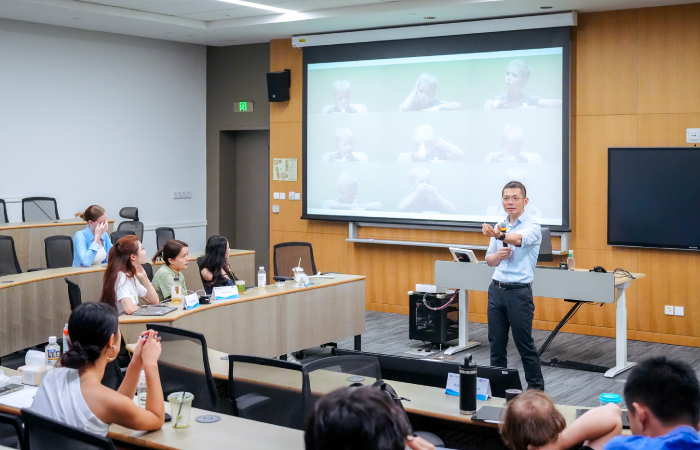
You were awarded the 2024 Baosteel Teaching Excellence Award -- the first NYU Shanghai faculty member to receive this honor. Could you share with us your teaching philosophy?
Teaching wasn’t part of my original career plan, but I’ve come to love it. As a teacher, I see myself as both a director and a performer, as it involves designing the structure, paying attention to the pace, and interacting with students.
After every class, I reflect on what worked well, what could be improved, how students reacted. I also like to talk about the latest cases in real life in the classroom, such as marketing campaigns, policy initiatives, or social behaviors that students witness in daily life. That way, theory becomes more tangible and meaningful.
Outside academia, what do you enjoy doing?
I keep a fairly disciplined lifestyle. I enjoy going to the gym after dropping my child off at school in the morning. Exercise helps clear the mind. I also pay attention to my diet.
I’m not a fan of excessive competition or burnout culture. For me, consistency leads to progress. Doing a little every day, whether it’s research, writing, or teaching. Small and steady steps add up over time.
Staying curious about yourself and others is essential both in research and in life.