

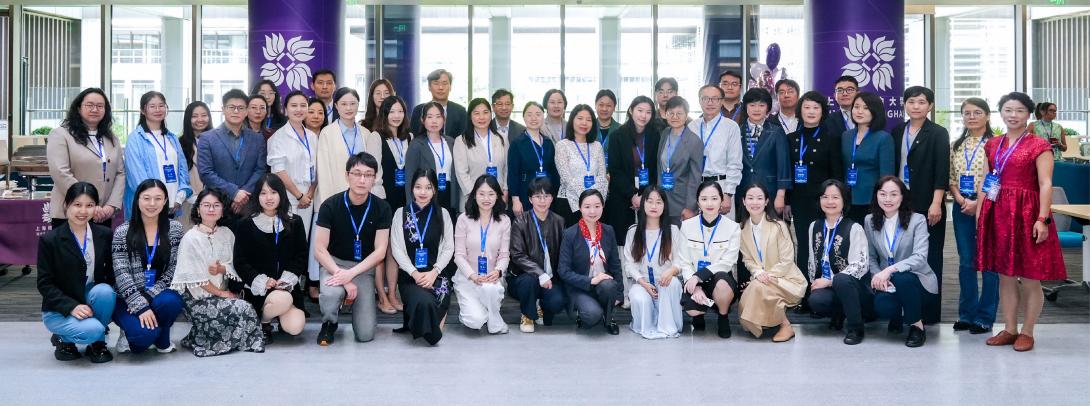
From April 25 to 26, NYU Shanghai hosted AI and Emerging Technologies in Advancing Aging Research, a seminar co-organized by the School of Nursing at Fudan University, the School of Nursing at Soochow University, and the School of Social Development at East China University of Political Science and Law. The event brought together approximately 50 scholars and industry experts from leading institutions in China and abroad, including Tsinghua University, Peking University, Fudan University, Zhejiang University, Duke University, and New York University.
The seminar opened with remarks by NYU Shanghai Provost and Distinguished Global Professor of Public Health Bei Wu, who noted that as Chinese society increasingly pays attention to healthy aging and longevity, new technologies such as AI create important opportunities for aging research.
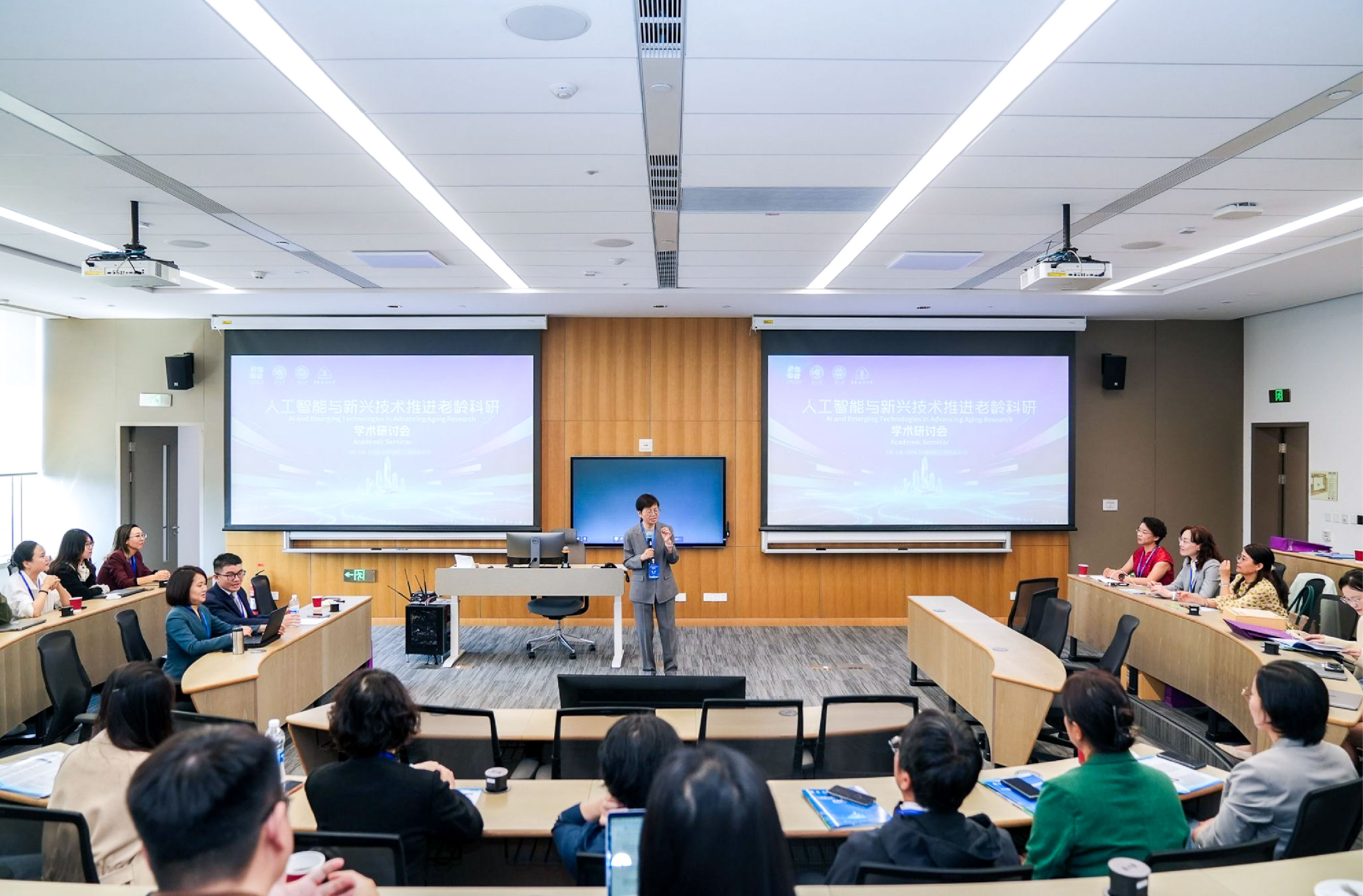
In the opening keynote address, Tsinghua University’s School of Healthcare Management Associate Professor Nan Jiang presented research on digital pathways to cognitive health for older adults. She introduced novel methods for assisting Alzheimer’s disease diagnosis, as well as a cognitive screening app designed for older populations. Her presentation demonstrated how precision screening can be integrated with daily cognitive training to build accessible intervention models that extend from clinical settings into communities and households.
Huzhou Normal University School of Nursing Professor Lina Wang addressed the complexity of nursing challenges and fragmented healthcare data. She outlined three core technological approaches—digital monitoring, predictive classification, and assisted intervention—and argued that true empowerment lies not in isolated tools, but in transforming research paradigms through deep interdisciplinary collaboration among nursing, engineering, computer science, and the humanities.
The second session focused on academia-industry collaboration in aging research. Fudan University School of Nursing Associate Professor Zheng Zhu and Jiaqing Wang, a senior engineer at Shanghai Lianhong Technology Co., shared practical experiences in using medical large language models and AI agents in healthcare settings. They emphasized that medical AI must evolve from merely being usable to being reliable, and should function as an enhanced assistant rather than a replacement for physicians.
Ding Ding, a professor at Huashan Hospital affiliated to Fudan University, presented findings on early identification of dementia using blood and imaging biomarkers. Drawing on the 15-year Shanghai Aging study, she highlighted the value of peripheral blood biomarkers in predicting progression from mild cognitive impairment to Alzheimer’s disease.
Ying Zhang, a professor at the Stomatological Hospital affiliated with Fudan University, showcased how AI is being applied across the full continuum of oral healthcare—from prevention and screening to diagnosis, treatment, and long-term management—and outlined the future development of integrated AI workflows in dentistry.
The first day concluded with a roundtable on collaboration across academia, industry, and research sectors in the aging field. Panelists discussed how to build long-term interdisciplinary partnerships, navigate policy environments, integrate resources, and ensure that collaborative outcomes move beyond formal agreements into practical implementation.
The second day centered on publishing research in top-tier journals. Zhejiang University School of Public Health researcher Zuyun Liu shared his team’s work on precision assessment of aging. Using data from a 12-year longitudinal cohort in a small city in Jiangsu Province and combining machine learning with multi-omics data, the team developed a series of original aging assessment models and identified the significant influence of childhood trauma and socioeconomic inequality on aging heterogeneity.
Yao Yao, director of the Center for Aging and Health Interdisciplinary Science at Peking University’s China Center for Health Development Studies, delivered a candid talk on the challenges behind publishing in journals such as The Lancet. In his talk, he included examples of multiple iterations of manuscript drafts, illustrating that strong research is built through continuous revision and refinement.
Duke University School of Nursing Associate Professor Hanzhang Xu shared practical lessons learned from publishing in elite journals, including three case examples of rejected manuscripts. She emphasized the importance of reframing research questions as actionable intervention targets and encouraged young scholars to be bold and build networks.
A final roundtable on publishing strategies in the age of AI featured perspectives from authors, editors, and reviewers. Panelists agreed that while AI tools can improve writing and analytical efficiency, the true value of scholarship depends on independent judgment, intellectual taste, originality, and the ability to address real-world problems.
In her closing remarks, Provost Wu encouraged researchers to focus not only on data and innovation, but above all on the problems their work helps solve—whether in clinical practice or in public policy. She reaffirmed NYU Shanghai’s role as an important bridge for academic exchange between China and the United States and expressed hope for building cross-generational and international scholarly networks that will contribute to aging research in China and around the world.