

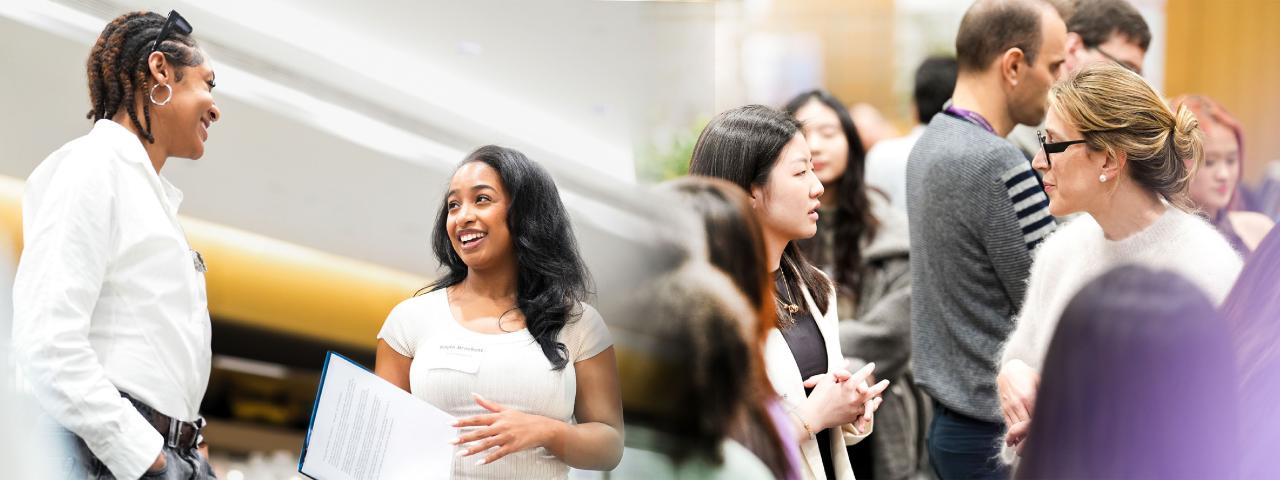
The most inspired research sometimes comes from questions about our everyday lived experiences. That’s what motivated several NYU Shanghai students as they were looking for research topics to explore. At NYU Shanghai, student research is often not separate from life but a way of making sense of it.
Like many first-year students applying for the Dean’s Undergraduate Research Fund (DURF), Zhou Jixuan ’28 of Business and Finance and Maths majors and Huang Jinkun ’28 of Economics major initially considered more profound, data-driven research topics. But they soon realized that what they lacked in advanced methodology, they could make up for with their lived experience. Rather than looking outward to understand a “big” abstract question, they turned inward, asking what could be revealed by their own experiences.
Their attention soon turned to their experiences in the classroom, and group class assignments gone wrong. They wondered why group assignments often end up with uneven contributions by teammates, a common occurrence that is endured but rarely questioned. At first they considered it as just a simple annoyance, but when they started questioning the phenomenon, their curiosity led them to their research question: what drives this “free-riding” behavior and how much of it is shaped by the way students are evaluated in courses?
In their first-year classes, both had experienced different forms of “free-riding” in group work context. Conversations with peers revealed that their experiences were not isolated. What if, they wondered, the issue was not just individuals’ behavior, but the education structure itself?
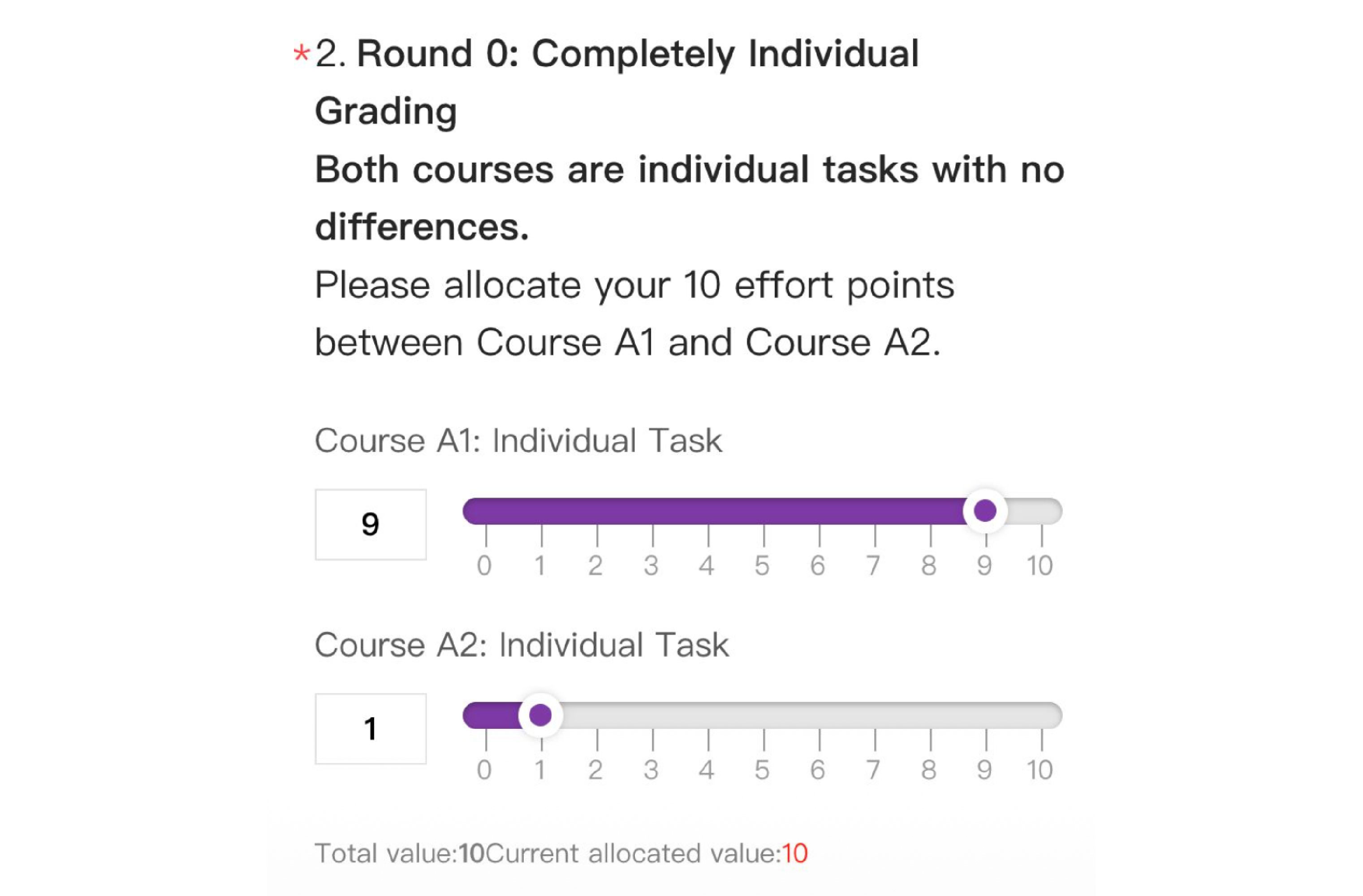
They focused their research on how different grading mechanisms influence student behavior in group work. Through a carefully designed survey, they simulated how students allocate effort across courses under varying evaluation systems.
The results aligned closely with what they had observed in real life: even when courses were equally important, students adjusted their effort based on how they were evaluated. Certain grading systems unintentionally encouraged disengagement, while others promoted more active participation.
For Jinkun, the value of the research lay in its practical relevance. “I’ve always cared about whether something connects back to real life,” she said. “And in this case, it actually did.” While Jixuan initially believed that individual responsibility largely determined the quality of group work, she later realized that the structure of evaluation plays an equally—if not more—significant and fundamental role.
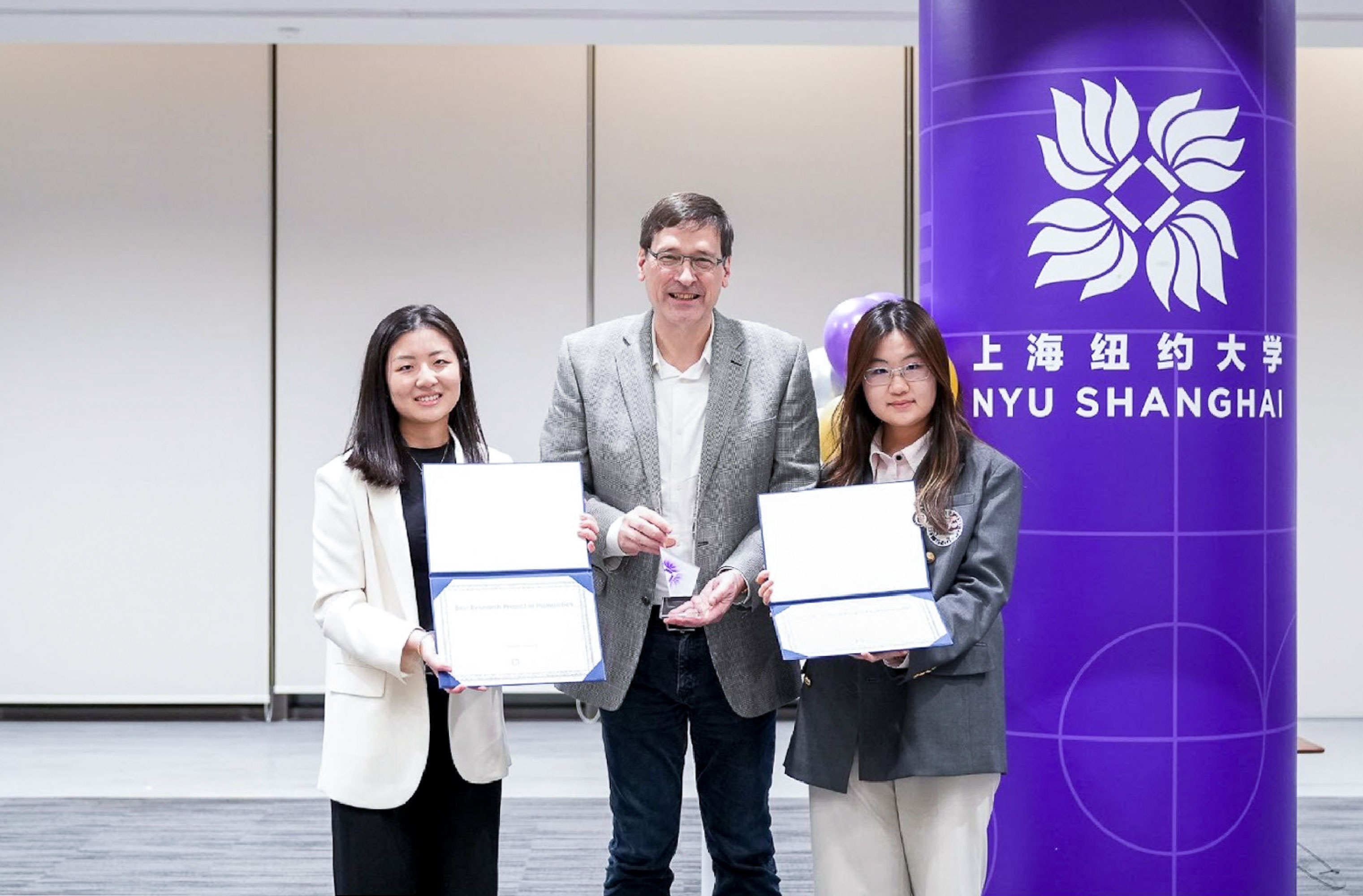
The pair’s research won them Best Research Project in Humanities at last fall’s Undergraduate Research Symposium, and to their surprise, they’ve seen their research have a greater impact. Some of their instructors even began referencing their findings while rethinking their grading practices.
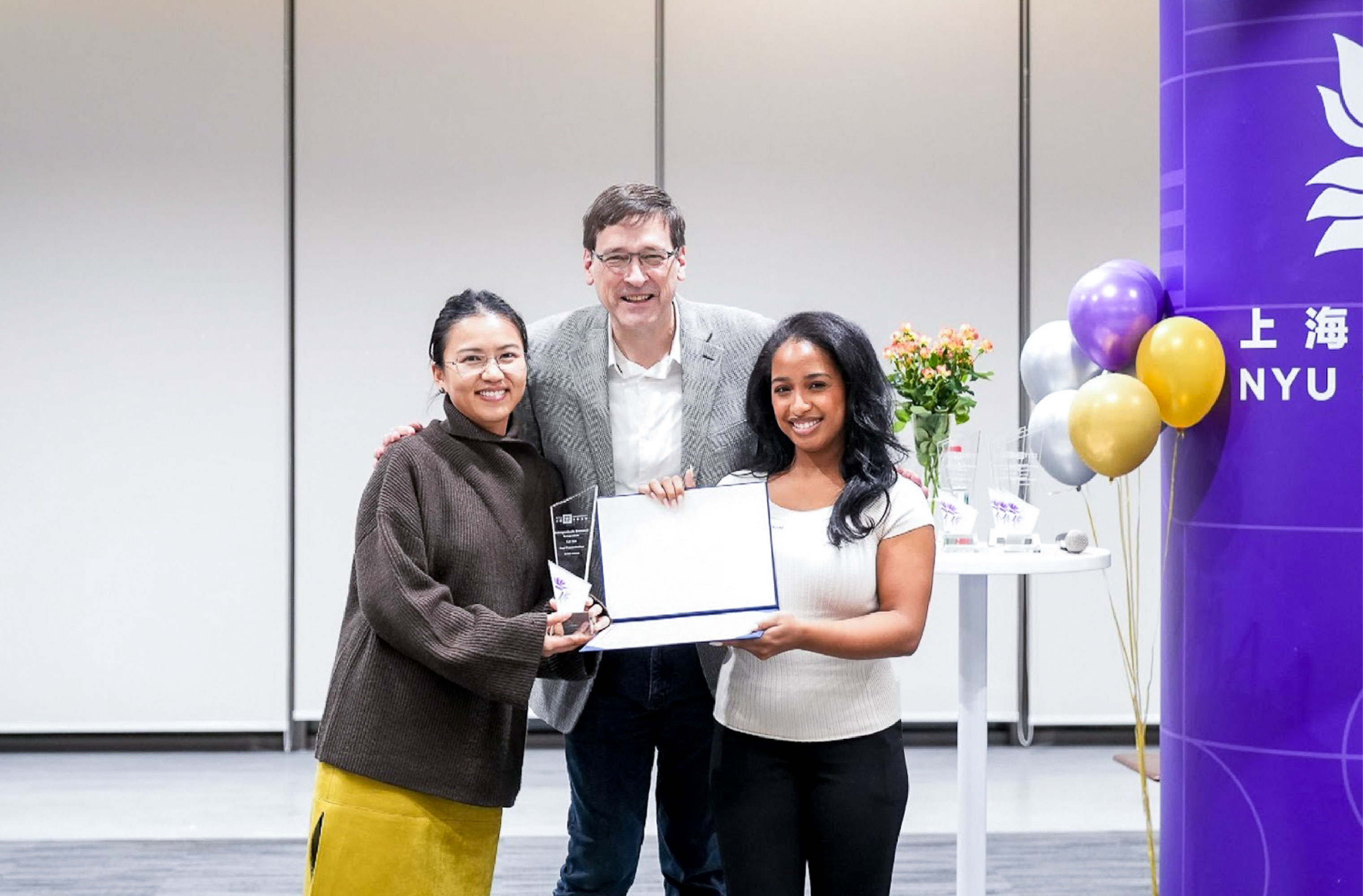
When Kayla Brackett ’26 of Social Science (International Relations track) major and Global China Studies minor, awardee of the Best Presentation in Social Science, was looking for a research question, it wasn’t the classroom that inspired her, but rather the social issues she navigated on a daily basis.
While studying away in London, she took a course related to immigration and noticed waves of xenophobic protests near campus. As part of her coursework, she began examining how hate speech was disseminated in public spaces and online. She was struck by not only the volume of hateful content, but also the patterns in how anti-immigration narratives were constructed and circulated.
Kayla wanted to make her research more accessible to a general audience, so after returning to Shanghai, she made a decision to step out of her comfort zone of qualitative research. She learned a new methodological approach, Epistemic Network Analysis (ENA), under Dr. Zixi Chen, which enabled her to visualize relationships within large bodies of social media text.
The process was demanding. She manually worked through her dataset, carefully coding and organizing information. Because the algorithm couldn't automatically recognize the specific wording, "It took time,” she said, “but it also helped me see patterns more clearly.” By translating observations into structured analysis, she was able to present complex ideas in a more visually compelling form. As she dissected the logic behind each anti-immigrant tweet, she discovered that hatred exists at the micro level of daily life; it is so commonplace that it is amplified into public discourse before we even realize it.
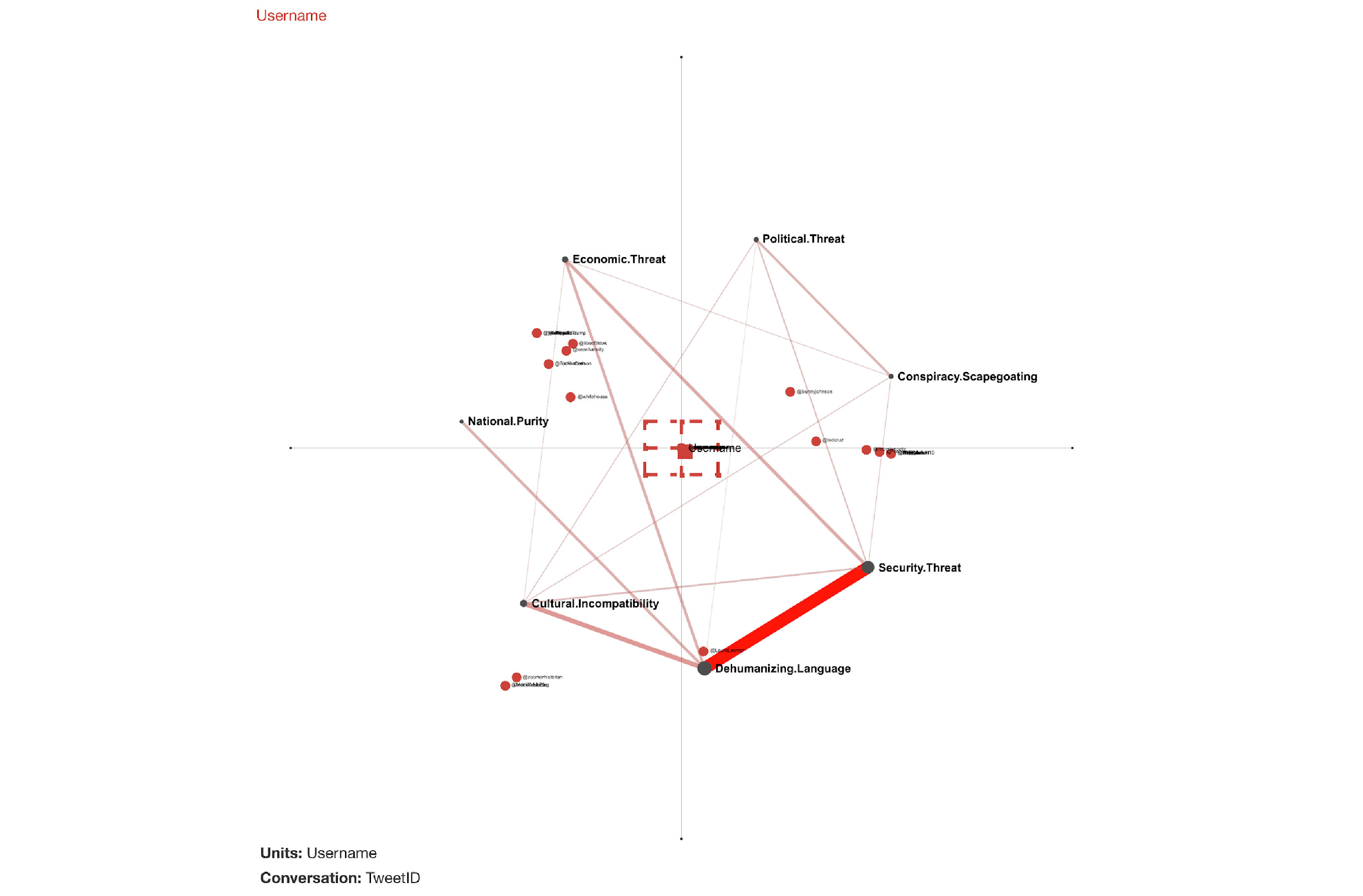
Kayla found that it was equally important to learn how to communicate her findings. “It’s not enough to do the work,” she said. “You also have to convince others of the value of your research.”
Presenting research in just three minutes to a roomful of people required clarity and precision. Through repeated practice, she refined her delivery—simplifying her language, focusing on key insights, presenting with confidence, and making her work understandable to a general audience.
For these student researchers, the goal is not to nail down a definitive answer, but rather to find a way to make sense of their own experiences. Research offered Jixuan a kind of freedom—the space to follow her curiosity, rather than work towards a “safe” answer. For Kayla, the research allowed her to delve into an instinctive response and develop a way to articulate evidence-based findings with clarity. Research helped them pursue questions rooted in personal experience and uncover a deeper understanding of society.