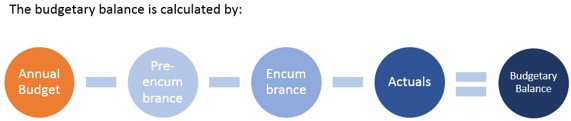

Budget owners/Cost center managers are responsible to check if requisitions, payment requests and expense reports, etc. are reasonable and within the budget. Budget teams are responsible for budget check review. Once a budget is overspent, budget team will contact responsible budget owners/cost center managers and work together to find out solutions in time.
Budget Control Q&A
- 01.How to make budget control?
- 02.Where to find the budget information of a specific cost center/program?
Several reports in Workday will help you to review the budgetary balance and details.
- "SH Budgetary Balance Report - Summary/by Month" report helps to review the budgetary balance and detailed transactions of each Cost Center/program;
- "Manager Budget Report- All" report gives a quick overview of the balance for all programs;
- "SH Journal Lines for Organization" report provides detailed accounting records of all transactions with multiple items, e.g. cost center, program, ledger account, spend categories, accounting date, transaction amount, memos, etc. The user could make various analysis based on the database.
- 03.Who are authorized to view the budget-related report?
Budget owners/cost center managers/program managers are the default users of budget-related reports for their own cost centers/programs. Besides, cost center/program financial analysts are also authorized accessing to the reports.
- 04. How to delegate authority to cost center / program financial analysts for the report view access?
If cost center managers need to delegate authority to cost center / program financial analysts, please submit a request to Calvin Li (Assistant Director, Office of Program Management; Email: zl29@nyu.edu; Phone: +86 (21) 20595888) to set up relevant roles in Workday. It will be further approved by responsible Finance staff.
- 05.What’s the definition of “Annual Budget”, “Pre-encumbrance”, ”Encumbrance” and “Actuals” in the budgetary report?
The definitions are as follows:
Fiscal year: A Fiscal Year is a financial year that differs from a calendar year. The calendar year of January 1 to December 31 does not match up with the main operations of NYU Shanghai. Therefore, NYU Shanghai has chosen September 1 as the start of the Fiscal Year, as that is typically the beginning of the fall academic semester. The end of the Fiscal Year is August 31.
Annual Budget: The Annual budget is the budget established for the beginning of the fiscal year, and incorporated with relevant approved budget adjustments.

Pre-encumbrance: A Pre-encumbrance is a method to set aside or reserve a budget for a specific purpose. It is used in a step previous to the encumbrance. This shows where the transaction is in the process of spending.
Encumbrance: An encumbrance is similar to a pre-encumbrance. It is a higher level of commitment than a budgeted expense, because money is reserved for a specific purpose. However, the transaction has not occurred yet so it is not an actual expense.
Actuals: Actuals are often referred to as “expenses”. When goods or services are well received or completed, a supplier invoice will be created to recognize expenses, which will be recorded as Actuals. An expense must first pass through the Budget Control process before it posts to the General Ledger. Actuals also include the expenditures from Expenses Report, Payment Request and etc.